Welcome back to the front porch, friends! Today, Caitlin Estes, a Certified Fertility Care practitioner with a Master of Divinity degree, comes with a unique blend of theological depth and clinical expertise to an area we’re all thinking about but may not have the language to talk about—our female bodies. She’d be the first to remind you that your body is complex by design and meant to point toward the spectacular nature of God. Grab a cup of hot tea and pull up a chair. This is not your grandma’s body conversation.
Guest Post by Caitlin Estes
Let me ask you a personal question: Do you like your body?
When you look at it in the mirror, how do you feel?
What do you think?
Your body is what smells honeysuckle in the summer, feels the waves on your toes, and hugs the ones you love, but it’s also what experiences stomach aches, broken bones, and fevered chills. I get it—how you feel about your body can be tricky.




How each of us answers the question is impacted by thousands of experiences throughout our lives.
If you were laughed at as a child, you may feel like there’s something wrong with your body. If you’ve been ogled by men, you may view your body as a vulnerability. If you cannot conceive, you may feel that your body is a frustrating hindrance to the family you’ve always dreamed of.
I doubt that any of us would come right out and say that our body is explicitly bad, but can you say with confidence that your body is explicitly good?
You may wonder if your answer to that question really makes a difference—it does. How you view your body can never be neutral; it has consequences. How we view our bodies directly impacts how we treat and respect them, and how we expect others to. No wonder we struggle with insecurity, frustration, and shame!
Even more than that (and that’s big), what you think about your creation impacts what you think about your Creator. So it’s important to get this right. It’s worth it to explore these bodies of ours and what God intended when He created them.
In His Image
After creating the heavens and the earth, the light and the dark, the land and the oceans, the vegetation and the livestock, God created humankind.
Then God said, “Let us make humans in our image, according
to our likeness, and let them have dominion over the fish of
the sea and over the birds of the air and over the cattle and over
all the wild animals of the earth and over every creeping thing
that creeps upon the earth.”
So God created humans in his image,
in the image of God he created them;
male and female he created them.
God blessed them, and God said to them, “Be fruitful and muliply and fill the earth and subdue it and have dominion over the fish of the sea and over the birds of the air and over every living thing that moves upon the earth.” . . .
God saw everything that he had made, and indeed, it was very good. And there was evening and there was morning, the sixth day. (Gen.1:26–28, 31)
Human beings are the only creation of God who receive a little introduction: Let us make humans in our image, according to our likeness (Gen. 1:26).
There is something about humanity that is so uniquely other from all of creation that it stands out and above the rest. Even the way in which God crafted us is different:
Then the Lord God formed man from the dust of the ground and breathed into his nostrils the breath of life, and the man became a living being (Gen. 2:7).
I love the image of God gathering up the rich, fertile earth and breathing life into it!
“Your body, your presence, your story, and your life reflect an image of God the world is desperate to see—not because of what your body has done or has not done, not because of marital status or motherhood, but because you are His.“
This is something totally new—neither spirit nor animal. Here, God combines the clay of the earth with the life of His breath and creates something very good: humankind. We are physical and we are spiritual; we are spiritual and we are physical.
These verses give us a clear picture that this combination was intentional—this design, personal. Through it, humankind reflects the image of the Creator God. Nothing in all of creation can compare to the beauty and significance of ours— and that’s really saying something.
Have you ever stood in the whipping winds of a mountain top, surveying all that is before you? Or marveled at the sunset in the open lands of Wyoming? Because that last one has happened to me.
My husband had a work conference in Montana a few days after I had a conference in Colorado, so we decided to rent a car and drive from Colorado, through Wyoming, to Montana. I had never been in that type of landscape before, and I was amazed at how open it was. We could look in all directions with absolutely nothing hindering our sight. There were no buildings, mountains, tall trees, or developments—just openness. That evening, as we drove along this vast expanse of sky and earth, the sun began to set.
I had seen pretty sunsets before, of course, but nothing compared to this. It was an explosion of orange, pink, purple, and blue that transformed the entire sky. As the sun began to creep toward the horizon, a pillar of clouds covered the rays and shot light and color in every direction—truly, it seemed to encompass every ounce of that openness as we pulled over to the side of the road. We simply couldn’t drive on when this holy moment was before us. I cried from its beauty.
I look at pictures of it today and can’t bring myself to be disappointed in them. I’m not at all surprised that they couldn’t capture the glory of the display. My soul remembers, though, and that’s enough. It was the most beautiful, moving thing I’ve ever witnessed— one of those moments when creation seems to pull back the veil and remind us that glory is real.


There are moments in this life that carry a particular kind of holiness: the first cry of any newborn child in the world, the fragile beginning of any life entrusted to love. Every new life in the whole world bears witness to something profoundly holy—and deeply good.
“Every new life in the whole world bears witness to something profoundly holy—and deeply good.“
Even the most majestic moments in nature cannot compare to the magnitude and beauty of a human life.
This is the imago Dei—the image of God in us.
Your body, your presence, your story, and your life reflect an image of God the world is desperate to see—not because of what your body has done or has not done, not because of marital status or motherhood, but because you are His.
Your body reflects an image of God the world is desperate to see. Others need to know the God of well-ordered beauty, of miraculous new life, and self-sacrificing love. They yearn for the One who will not only comfort, but satisfy.
So preach the gospel through your “irreplaceable, indispensable, unrepeatable,” female life.
Reflect the love of God in the world as you point yourself and others back its Source: your Creator, Redeemer, Sustainer—God.
When we think of being a woman, it’s easy to feel the pain points. Yet, as believers, we desperately hope there’s more to it than this.
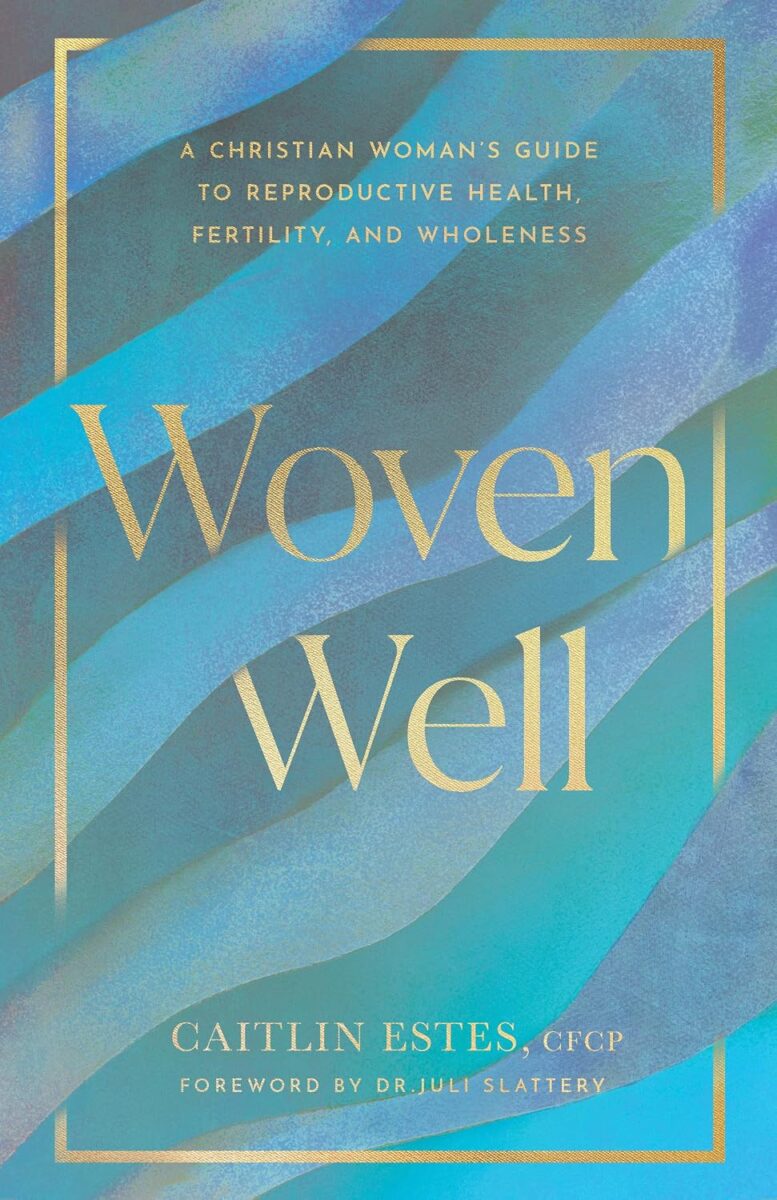
Certified FertilityCare Practitioner Caitlin Estes believes that female bodies matter, that our reproductive design isn’t intended to be pointless and punishing, but infused by God with significance and purpose. Drawing from her theological education and clinical expertise, Caitlin connects theology, women’s stories, and practical education in her essential book Woven Well.
Woven Well explores culture’s broken perception of the female body and paints a theologically rich alternative. God designed female bodies for our flourishing and for the flourishing of the world. Readers discover just how much this influences our options and expectations for things like birth control alternatives, infertility treatments, and reproductive medicine.
If you want to navigate women’s health issues and questions with confidence, honor your design as an image bearer of God, and reclaim God’s dignity for the female body, you’ll find this and more in Woven Well.
{Our humble thanks to Moody Publishers for their partnership in today’s devotional.}