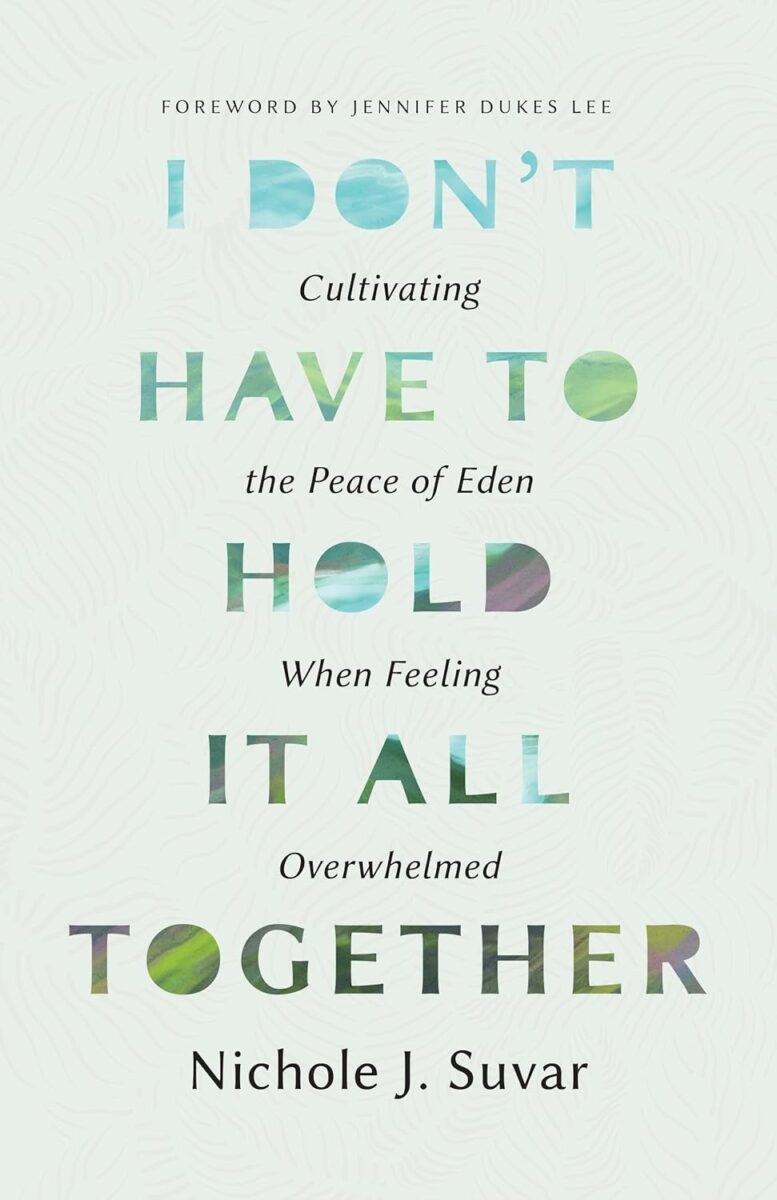
Sometimes you meet a woman and you can feel it—she’s done the quiet, hidden work of wrestling her way through the dark and coming out with a gentler grip on life. Sometimes the loudest battles we fight are the ones no one else can see—the quiet spirals of what-ifs, the pressure to hold everything together, the ache for peace that never quite settles. I’m grateful to introduce you today to someone who knows that place well. In her book, I Don’t Have To Hold It All Together, Nichole J Suvar guides us with her gentle sit-by-your-side nature as she helps us see a different way through our chaos. Not through building more control but by loosening our grip on it. Today, Nichole invites us toward a peace that isn’t fragile or fleeting, but rooted in something far more steady than ourselves. It’s a joy to welcome Nichole to the farm’s table today…
Guest Post by Nichole J Suvar
My breath is shallow and quick, and the butterflies in my stomach are working overtime.
I rub my hands against my jean-clad thighs, trying to dry the sweat off my palms.
I’m not standing before a crowd giving a speech or waiting for a medical procedure to start.
I am sitting at my school desk, an anxious eight-year-old girl.


My thoughts bounce from one what-if scenario to another, and I struggle to concentrate on the lesson my teacher leads at the front of the class. Though the feelings are familiar, I don’t know what to do with them.
“We convince ourselves that if this one thing reaches our expectation, then the anxiety will be stilled. “
When I voice them to my parents or a teacher, they simply tell me, “Don’t worry about that! It’s no big deal.” They mean for their words to be a balm, assuring a young child that the big worries in her head aren’t that big after all.
So, I follow their instructions to be a good student and daughter. I try not to worry about all the what-ifs. I imagine myself putting my hands on the pile of worries and pushing down with all my strength, trying to shove it into a deeper, darker space where I can’t hear it and it won’t plague me.
As I shove it down, tendrils waft back up, threatening to curl around my throat, lungs, and thoughts. I start focusing on my handwriting, making it as neat and orderly as possible. I look over to the student’s desk next to me. Their pencil is lined up perfectly on their desk, and they are calmly completing their schoolwork. I convince myself that the perfection I see next to me directly correlates to the peace that the student is showing. If I try harder to perfect my outward world, my inward world will fall in line.
Though we can shake our heads at this 8-year-old’s schemes for reducing the anxiety in her mind, we’re still guilty of this as adults today.
“God did not design us to be the primary creators and providers. Humans were placed in Eden to cultivate what He had already made and provided.“
We may not be straightening the pencils at our desks and focusing on the best handwriting possible. Instead, we continue to order the chaos in our lives. We over-fixate on a craft project, a specific room in our house, a family member, or a work project. Poking, prodding, and manipulating it until it reaches the level of perfection and expectation we have in our heads. We convince ourselves that if this one thing reaches our expectation, then the anxiety will be stilled.
In Genesis 1:28 (NIV), God gives a command to the humans He had created in His image: “Be fruitful and increase in number; fill the earth and subdue it. Rule over the fish in the sea and the birds in the sky and over every living creature that moves on the ground.”
After God created humans in His image, He gave them the task of filling the earth with offspring and controlling the world and its creatures. We were given ownership and authority in the world and called to be good stewards of what we possess. God handed out this command before sin entered the picture, and because the command was from God, it was good.
He instructed us to be in control.
But, without sin in the picture, that would have looked like handling what was given with care and being conscious of stewarding what was given to us to bring God glory.
“The problem with building your own Eden is that you are in charge of keeping and maintaining it. God did not design us to be the primary creators and providers. Humans were placed in Eden to cultivate what He had already made and provided.“
When sin entered the Garden, the desire that God implanted in you to steward and subdue became twisted. Instead of stewarding your blessings, you grab for the things that aren’t yours and wrestle into submission the things that belong to you. Do you feel this pull to control people, possessions, time, and your image?
Often, chaos can feel like ocean waves lapping at the shore of our souls. We build a sea wall of control around these waves, thinking it’s a surefire way to keep the tidal wave from getting us. We assure ourselves that our control is for the betterment of all around us, and we feel safe and comfortable.
Can you identify the walls you have built in your life to keep out the chaos? These aren’t the healthy boundaries that are necessary for all of us. These walls are about control and needing to establish comfort on your terms. Have you found a way to provide everything you need for yourself? Can you quickly name things that make you feel good and secure? You may have essentially built your own Eden.
The problem with building your own Eden is that you are in charge of keeping and maintaining it. It can take one upset schedule, argument, or diagnosis to dismantle the illusion of control you’ve created for yourself. God did not design us to be the primary creators and providers. Humans were placed in Eden to cultivate what He had already made and provided.


“…we have taken the gift of stewardship and twisted it into the desire to be in control. We have taken the gift of resting in our Creator for His provision and twisted it into our definition of comfort…”
In this post-fall world, we have taken the gift of stewardship and twisted it into the desire to be in control.
We have taken the gift of resting in our Creator for His provision and twisted it into our definition of comfort—things that give us temporary satisfaction and a false sense of peace.
When we feel anxious, we feel out of control.
The simplest route to go is to start controlling things that are within our reach.
Sometimes, it’s people, our schedules, or physical things like our home, and sometimes, it’s us, clamping down on our emotions and putting a brave face for the world to see. Whatever the control may look like, we cling to it with a tight fist. But the problem with tight fists is that we can’t do much else with them except hold on.
The path back to peace doesn’t come through tighter control, but through deeper trust.
God is already holding what you’re striving to manage.
You can release your grip, breathe again, and rest in the goodness of the One who provides.
You don’t have to hold it all together – He already is.
As a chronic overthinker and life-long anxiety warrior, Nichole J Suvar, knows the strong pull of needing to hold it all together.
Today, as an author and speaker who knows what it feels like to live overwhelmed, rushed, and stretched thin by anxiety, she helps women slow down, understand what’s beneath their overwhelm, and step into a more grounded, purposeful life—one that reflects the peace God designed for them.
In her latest book, I Don’t Have to Hold It All Together, Nichole explores the attributes of Eden that are still present here today to help us access God’s presence and peace- the Eden we still carry.
Nichole lives with her family in Northeast Indiana. She collects chairs – the more colorful the better, thinks all the best food is in sandwich form, and will stop everything to read a map. She’s a fan of hiking, cozy cardigans, and Earl Grey Tea, and she’s learning that life unfolds better with open hands rather than tightly held control.
Connect with Nichole at livewithintent.org and pick up I Don’t Have to Hold It All Together here!
{Our humble thanks to Moody Publishers for their partnership in today’s devotional.}