I’ve personally and deeply known Jenn Tucker as one of my dearest friends for the last 10 years & she is nothing if not a genuine woman of the Word. A woman who trusts that God is trustworthy, that He communicates, and a life of intimately communicating with Him, and daily listening to Him, leads to a life of deeply fulfilling communion, even, especially, in crisis. And as two very close friends who can testify to this truth, two mothers, two daughters of the King of kings, Jenn and I have long walked together through some achingly dark nights of the soul, standing with each other, kneeling with each other, grieving with each other, breathing prayers with each other, for each other, and the hard things become holy things as we bring them to Him. It’s one of my greatest joys to welcome Jenn to the farm’s table today…
Guest Post by Jennifer Tucker
The sky wept with us the day we said our final goodbyes to our beloved Papa.
He was my last living grandparent, and he was my friend.
A deep grief settled over my soul on that rainy January morning, and it lingers still today.





It’s been five months now since we lost him. Five months since I kissed his forehead for the last time. Five months since I heard his voice, since I held his hand, since I saw his smile.
Sometimes grief crashes over me in waves and knocks me off balance. Sometimes it slips in quietly in the cracks of mundane moments, whispering its ache into my heart. Sometimes it is a lingering shadow, darkening the edges of the day.
Just last week, I was cleaning out a drawer and I ran across a card he gave me for my birthday a couple of years ago. The front of the card was pink with bicycles covered in flowers, and it was titled “True Friends.” Inside, he wrote, “Not only are you my first granddaughter, you are one of my best friends.”
I miss him.
Sometimes this life feels like a continual emptying—a long and winding story of loss after loss after loss.
The last few years have brought a series of various losses into my life, seasons of grief upon grief. The loss of dreams and plans, the loss of health and friendships, the loss of how I thought our story would go. Our storyline has turned in ways I never would have written, with years marked by crises I struggled to navigate, challenges I never saw coming, and suffering I never expected. Over and over again, it has felt like the waves just keep crashing down, each crisis chipping away at my strength, each loss taking a bit of myself with it.
As the losses pile, the darkness grows. And I could drown in this place, in this darkness.
“I thought that if I had any kind of mental health struggles, it meant I didn’t have enough faith, or I didn’t pray enough or pray the right way, or I just didn’t trust God enough.“
I could sit here under the heaviness of loss and the fear of even more loss, and I could suffocate from the weight of it all. Joy is snatched from my lungs and swept into this aching void within me, until all that is left is despair and sadness and anger—at all that I can’t control, all that I can’t change. And if I sit here long enough in this darkness, and all becomes numb, and nothing.
This is my experience with depression. This is how it has felt for me.
Depression is a black hole, draining me of joy and light, shrouding my days in a numbing fog. I want to just curl up, curl in on myself, and disappear.
Life requires so much energy, so much effort. Everything feels overwhelming and exhausting. It’s all just too hard, too much. And I can get stuck in that place, paralyzed by grief and fear and pain, numb to hope.
I used to think something was deeply wrong with me. For nearly forty years of my life, I didn’t have a real framework for adequately understanding mental health conditions, let alone any way of recognizing the symptoms in my own life. I thought that if I had any kind of mental health struggles, it meant I didn’t have enough faith, or I didn’t pray enough or pray the right way, or I just didn’t trust God enough. For years I ignored the physical symptoms in my body, and I pushed down difficult emotions. To feel was just too painful, to face the truth was too terrifying, to admit my struggles would be to admit some great failure of my faith.
“The presence of suffering does not equal the absence of God. “
But ignoring my depression didn’t make it go away. If anything, it made it harder for me to take actual steps toward peace and healing. But as I’ve learned more about my own mental health, about the ways my body processes stress and anxiety and pain, about the symptoms of depression and the ways it manifests within me, I’ve grown in compassion and gentleness toward myself, and toward the story that God is writing through my life.
My physical and mental health struggles are not the litmus test for my faith.
The presence of suffering does not equal the absence of God. I can let myself feel all of my feelings—even the anxiety, the despair, the fear, and the pain—and I can open my hands and hold it all up to the light, and let the loving arms of God hold me through it all.
So when depression swept in along with the grief of losing Papa, and I once again found myself sinking into that dark and numbing place and I began turning inward and shutting down, instead of ignoring or avoiding or pretending I was ok, this time I slowed down and I paid attention.
“…day by day, movement by movement, prayer by prayer, hope unfolds within me and Hope Himself enfolds me in His arms.“
I noticed the symptoms in my body. I let myself feel the weight of it. And I reached for tools that I’ve gathered through these last few years that help me hold to hope as I move through the hard things—gentle embodied practices that keep me turning toward the Light when the darkness presses in.
One such practice that has been particularly helpful to me is embodied prayer—gentle movement combined with simple prayers that engage the whole self—body, mind, and soul.
By engaging in movement as we pray, embodied prayers can help us access hope and connection when we’re feeling stuck in a place of shut-down and overwhelm. There’s a physiological reason for this. Did you know that every time you move, even if it’s the smallest movement, your muscles release proteins called myokines? These tiny proteins travel through the bloodstream and affect every system in the body, and can have a significant impact on how you feel and the way you process stress. They’ve been shown to help reduce inflammation, regulate blood sugar, strengthen muscles and reduce symptoms of anxiety and depression.
One of the first scientific papers about myokines actually called them “hope molecules” because of the power they have to improve mood andpromote emotional well-being. Isn’t that incredible? Every time you move, molecules of hope literally move through you!
Embodied prayer takes this power of movement and connects it to the power of prayer. As I gently move my body, I turn my heart toward God in prayer.
Every movement becomes an invitation to pray, to be aware of God’s presence with me and to connect to His abiding love as I move through my days.
And even when the grief remains and the depression lingers, and even if the pain doesn’t go away and the diagnosis doesn’t change, and even if the loss that I fear the most comes true—day by day, movement by movement, prayer by prayer, hope unfolds within me and Hope Himself enfolds me in His arms.






This is not some miracle cure or magical fix that will take away all your struggles and pain. We live in a broken, imperfect world with broken, imperfect bodies, and we live broken, imperfect stories and walk broken, imperfect roads.
“The answer to all our brokenness is not found in uncovering the miracle cure for our pain—it’s in experiencing the unwavering presence of God with us in the midst of it all.“
But there is a truth that is greater than all our collective brokenness: God is with us.
The answer to all our brokenness is not found in uncovering the miracle cure for our pain—it’s in experiencing the unwavering presence of God with us in the midst of it all.
God is with us. That is the miracle. That is our constant source of hope. Not just that some day in the future things will be better, but that right here and now we are not alone, that right now in the middle of the dark there can be peace and joy and hope because God is with us right here.
You may be living in the middle of a storyline you never wanted, walking a path you never planned, facing hard things you never asked for. Even here, God is with you. You are not alone.
And when you’re ready, when the weight lifts just enough to lift your eyes once again, you can look up and look around and you can see it: glimmers of hope are still surrounding you.
And when you have the strength to begin to move again, you can stretch your arms or wiggle your toes or simply take a deep breath, and you can feel it—hope is still moving within you.
Every breath is an invitation to breathe in His peace.
Every moment is an invitation to rest in His presence.
Every movement is an invitation to draw close to His heart.
Sometimes life feels like a continual emptying, a constant unfolding of loss upon loss. But it is also a continual filling, a constant enfolding of grace upon grace.
No matter how dark the dark gets, the glimmers of His love are still piercing through, the echoes of His goodness are still calling to you. Look, listen, feel—in every moment and every movement, He is here.
Hope is enfolding you and carrying you through.
The loving arms of God have never let you go.
Footnotes:
1 Kelly McGonigal, The Joy of Movement (Penguin Publishing Group, 2021), 191–193, Kindle.
2 McGonigal, The Joy of Movement, 191.
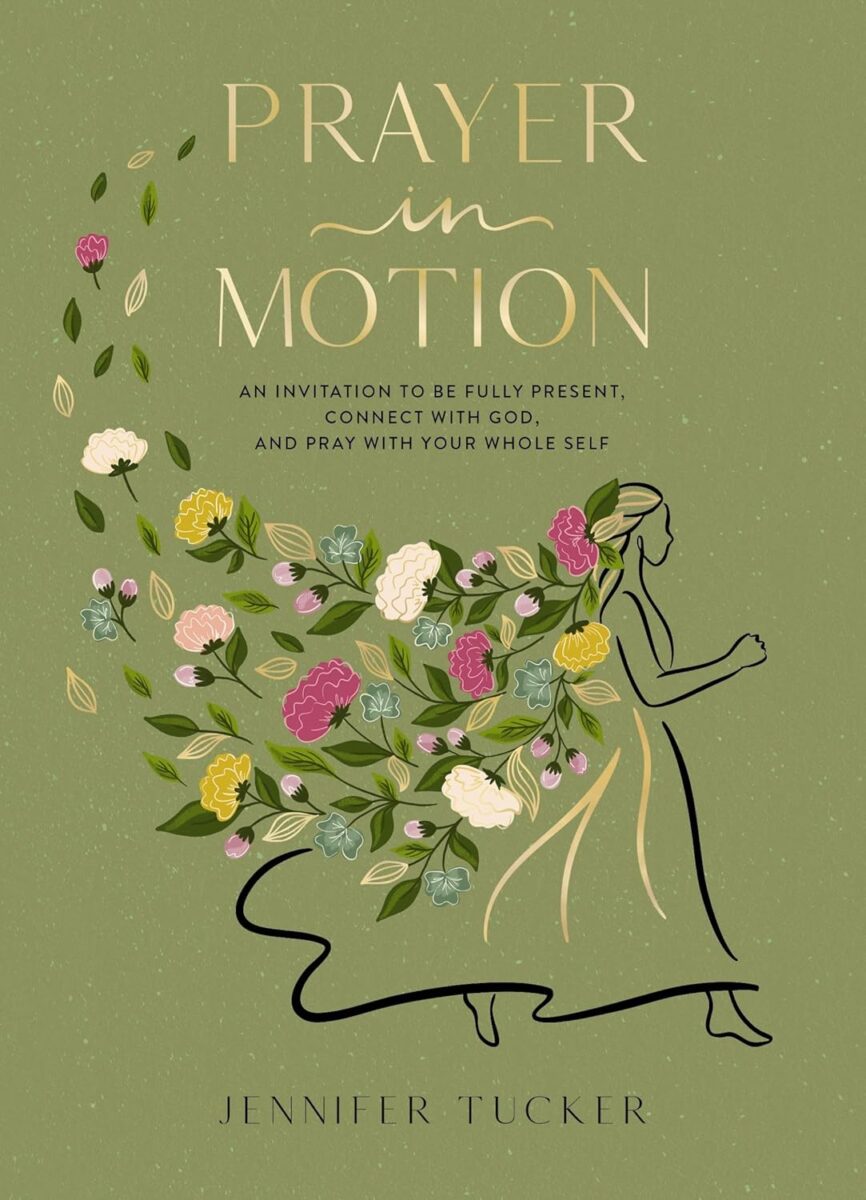
Cultivate deeply embodied rhythms of prayer that allow you to move through stress, connect with God, and experience greater joy and peace. Prayer in Motion is a gentle invitation to experience prayer in a fresh, embodied way—where movement becomes worship, and your physical self is embraced as an integral part of your spiritual journey.
With warmth and gentle wisdom, Jennifer offers a path to hope and deeper connection through simple practices that unite body and soul. You’ll be encouraged to slow down, create sacred space, and engage in meaningful somatic movement—from stretching and breathing to walking, dancing, and even playing—as you gently turn your heart and mind toward God through embodied prayer. Whether you’re feeling disconnected, stressed, or just longing to experience God in a new way, Prayer in Motion gently leads you toward wholeness—helping you reclaim joy, deepen faith, and find peace one intentional movement at a time. Learn more at prayerinmotionbook.com
{Our humble thanks to Thomas Nelson for their partnership in today’s devotional.}