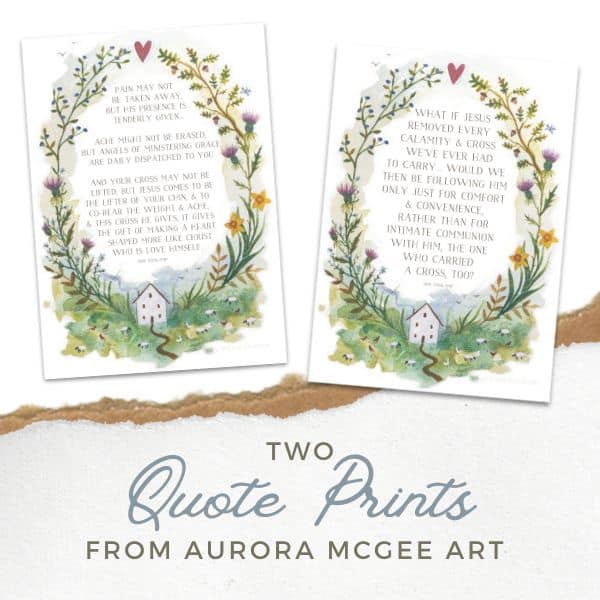
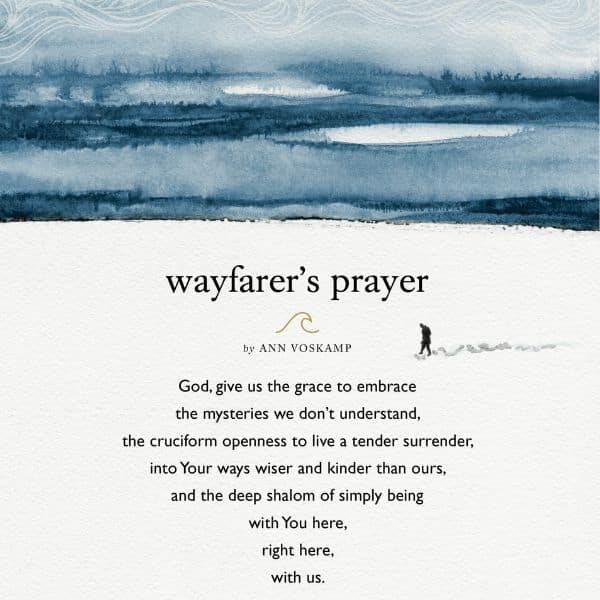
You know, sometimes we feel misplaced. Tender. Threadbare. And in those hollow spaces, we can wonder, Where is God? For over a decade, Allison Byxbe experienced sorrow upon sorrow. As the grief buried her, Allison was desperate for a way to reconnect to God’s presence. And, journaling through Scripture became her lifeline to God — and her deep wisdom has been impactful in my own life. Today, she invites us to trace the lines of grace through every season of our lives through the spiritual practice of journaling. It’s a joy to welcome Allison to the farm’s table today…
Guest post by Allison Byxbe
When our baby was diagnosed with a life-altering genetic disorder, I thought God had gotten our story wrong.
If He was omnipotent like I’d believed my whole life, then He was choosing not to intervene.
The ways in which I’d seen the goodness and kindness of God reflected in my life were now broken and cracked by pain and confusion.
“Pain seems to obscure our holy imagination for what God is doing right in the midst of our most difficult moments.“
Pain seems to obscure our holy imagination for what God is doing right in the midst of our most difficult moments.
If God wouldn’t change our circumstances, I would do it myself.
My scraped-raw soul tried to latch onto any shard of earthly hope I could to make my life normal again. Therapy and appointments and evaluations and late-night Google searches and alternative medicine became my work and my distraction, my way to numb the pain eating away at me. My self-sufficiency became the way I tried to prove to God and everyone that I could do this.
Honestly, as much as I was motivated to help our son, I was trying to find my way out of a life I didn’t ask for.


The lie of self- sufficiency became the glue I tried to use to hold myself together. Instead of I can do anything through Christ who strengthens me, I believed I can work my own way out of any pain I experience. I believed the lie that I had no worth, my son was broken, and I was unloved by God.
“When we look into the mirror of God’s love, we see patience, kindness, humility, deference, delight in truth, protection, trust, hope, and perseverance. This is the kind of love that wipes away the grit and grime of self-sufficiency.“
Instead of allowing the truth that God would grant me sufficiency for the joy of raising our son, I believed that achieving a good life for our family depended solely on me.
We think doing it ourselves is the formula for getting the life we want. It’s the old Edenic lie that when we’re in control, when we make the decisions, when we get what we want, then all will be right in our lives. The obsession with self-sufficiency, individualism, and success clashes head-on with Scripture, which exposes this destructive soul posture. Paul reminds us in 2 Corinthians 3:5: “Not that we are sufficient in ourselves to claim anything as coming from us, but our sufficiency is from God.”
I needed to remember that amid our sideways story I was still beloved of God, whole in Christ, and worthy of all of God’s good gifts. I needed the truth of love reflected in 1 Corinthians 13: “If I have the gift of prophecy and can fathom all mysteries and all knowledge, and if I have a faith that can move mountains, but do not have love, I am nothing.” In this passage Paul makes love the priority, the ultimate good, the highest value. The make-it-or-break-it necessity. The starkness of his language is intentional because the importance of love cannot be overstated.
When we look into the mirror of God’s love, we see patience, kindness, humility, deference, delight in truth, protection, trust, hope, and perseverance. This is the kind of love that wipes away the grit and grime of self-sufficiency.
“Truthfully, the mirrors we choose will either deceive us with their lies or transform us with Word-made-flesh love. “
Truthfully, the mirrors we choose will either deceive us with their lies or transform us with Word-made-flesh love.
Is your mirror distorted? Are you gazing through the smoke and mirrors of the enemy’s lies? What would happen if you turned your gaze to God’s clear mirror of love and all-sufficiency instead?
Journaling can be a way to hold up the mirror of God’s love, a mirror that helps us trace the lines of God’s good grace in our lives. Without reflection, we become “like someone who looks at his face in a mirror and, after looking at himself, goes away and immediately forgets what he looks like” (James 1:23-24). We can too easily lose sight of God’s transforming love when we fail to reflect.
As I began to journal about our experience with our son, I noticed that the heaviness was lifting, even if just a bit, and I could take a breath. I began to see new ways of thinking and being that I never would have seen apart from them staring back at me from the pages of my journal.
“We can too easily lose sight of God’s transforming love when we fail to reflect.“
My journal became a mirror, reflecting to me God’s truth, wisdom, and love. Because writing it all down helped, I continued, page after page, as honestly as I could. At the time I only knew that journaling was balm for my soul. Writing through my pain was healing me, and I needed as much of it as I could get. I was at the beginning of the long, often painful, but ultimately beautiful journey of replacing self-sufficiency with lament, depth, long-suffering, love, openness, and vulnerability word by word in the pages of my journal.
But there is a reason why writing through our pain is healing. Adam Young says it most simply and profoundly: “It turns out that the practice of reflecting on the story of your life actually promotes healing in your brain . . . [because] brain health is a function of the degree to which all parts of your brain are connected with one another.” Through this reflective writing, God can write healing into the lines of our broken stories.




Journaling was helping me heal from the destructive nature of self-sufficiency.
“I began to see that what I really needed wasn’t control but the ability to create meaning and insight from my story based in the over-abundant love of God.“
I began to see that what I really needed wasn’t control but the ability to create meaning and insight from my story based in the over-abundant love of God. It turned out that what our family really needed, even more than the therapies and interventions, was radical acceptance born from love.
God was already looking at my son, at our family, and the life He’d given us and saying it was good. I didn’t have to fight for the good life; I already had it.
Journaling helps us honestly examine the ways we’re navigating our stories. Journaling functions as this mirror where we put in plain view for ourselves the patterns of our thoughts. And then, when we journal God’s honest truth back to ourselves, we make visible the often invisible, intangible work of the Spirit in us.
What could happen in your story if today you chose to pick up a pen and write your heart straight back to the love of God?
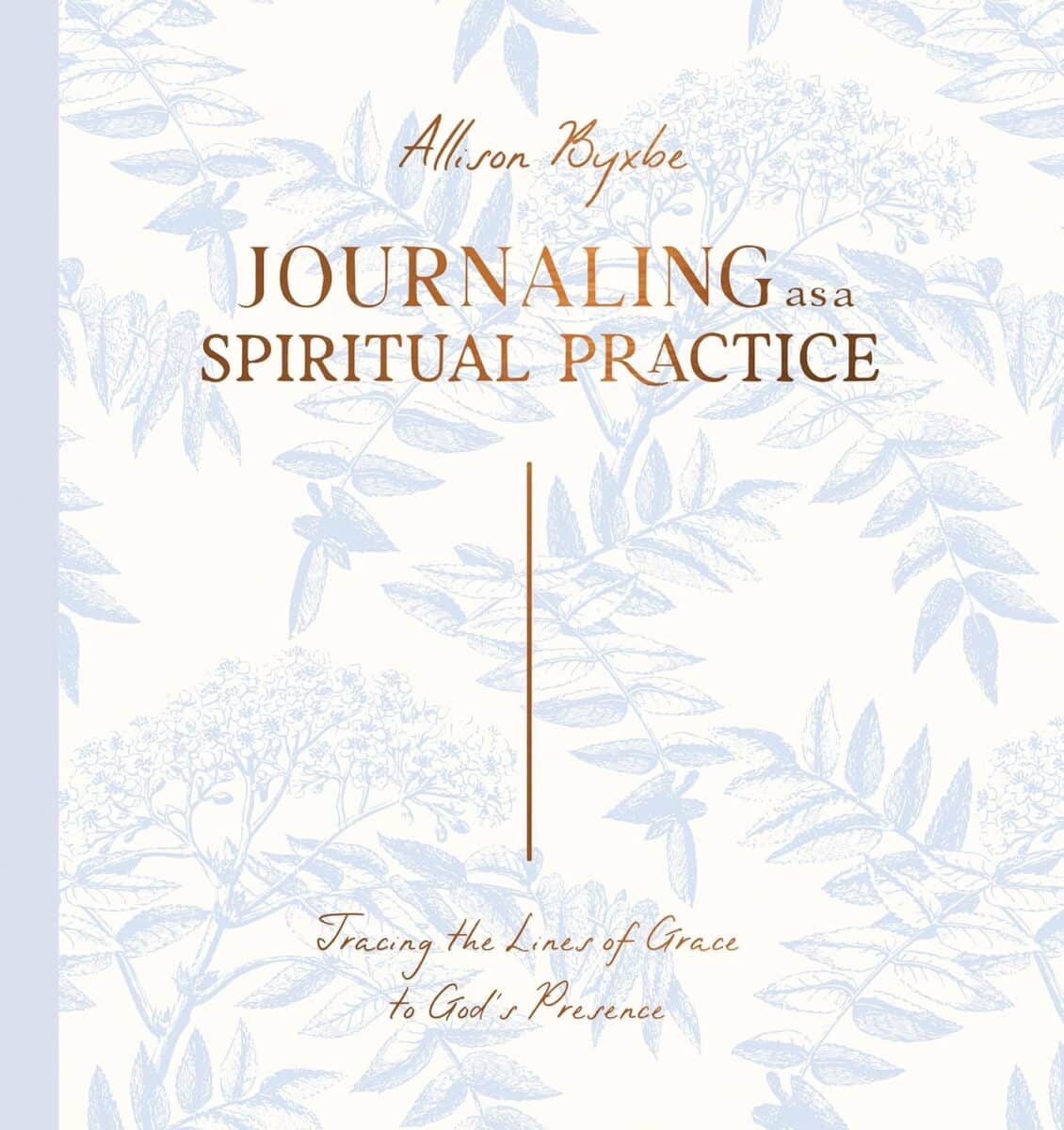
I’ve been keenly waiting for this book!
Allison lives in South Carolina with her husband and three children, where she is a college writing professor and a certified journaling instructor through the Therapeutic Writing Institute. Allison is the founder and host of Saturday Pages and The Inky Collective—two thriving journaling communities.
In Journaling as a Spiritual Practice, Allison shares her transformative journey from grief and depression to healing and wholeness. The Bible is filled with rich language and pictures that reveal our triune God—living water, bread, a door, a gentle whisper. Journaling through Scripture’s metaphors became her lifeline—a way to process the grief, to make sense of the impossible, and to encounter and then fully live in the presence of God once again. This book guides readers through the spiritual practice of journaling. Each chapter weaves in Allison’s journey, includes journaling examples and prompts, and shows you how to journal.
{Our humble thanks to Moody Publishers for their partnership in today’s devotional.}