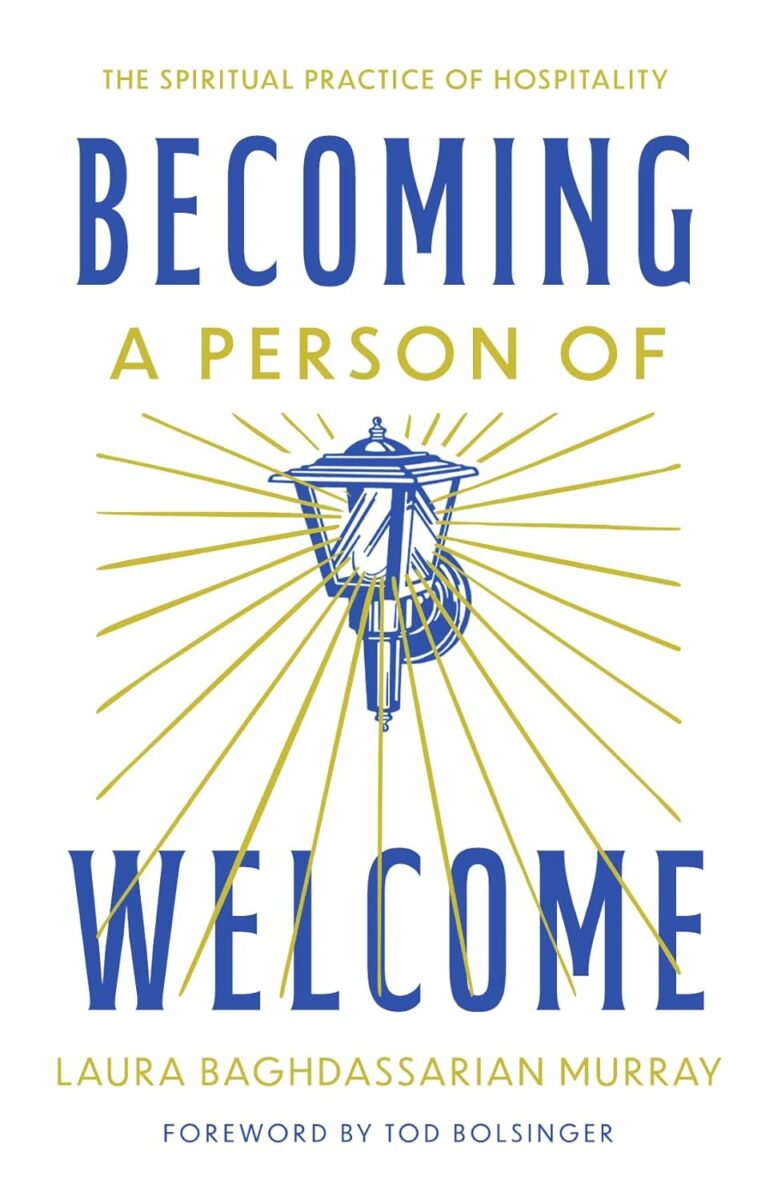
Many of us have a view of hospitality that includes homes and food. And these are both good things! Yet Christian hospitality is so much more than that. Many of us have experienced the warmth of welcome in the most unlikely places – overseas on a mission trip, from a cashier at the grocery store, or a stranger serving us when they see our hands are full. Our world desperately needs more moments of hospitality and we can be people who carry God’s hospitality into the world. Where do you need God to meet you with his welcome and love? Laura Baghdassarian Murray, author of Becoming a Person of Welcome, joins us on the farm today, sharing her own stories of culture and healing that encourage us to allow God to heal us so that we can be healers in the world. It’s a joy to welcome Laura to the farm’s table today…
Guest Post by Laura Murray
Growing up as a next-generation immigrant, I was keenly aware of how different our family was from many of the families in our neighborhood.
In addition to this cultural difference, my younger sister has Down syndrome.
In the neighborhood, in school, and the Armenian community, some treated our family differently because of her disability.
I didn’t know that people intentionally did this.
I imagine that they simply didn’t know what to do. Even so, these small rejections, avoidances, and exclusions added up.
We noticed and felt this when we were left out, looked past, and pushed aside. We were often moved to the outskirts of what was happening.
Community wasn’t easy to find in the neighborhood or in our cultural community.


The woman at the well (John 4:1‑26) also had a history of small rejections, avoidances, and exclusions.
The text tells us that she had been married multiple times, and was living with a man who was not her husband.
Commentators have often interpreted this to mean that she was an adulteress, shunned by her community. It may be more likely that she was divorced by her husbands, which would still be a recipe for being outcast.
What is noteworthy is that when she went back to her community to tell them about Jesus, they believed her.
This woman had a history of rejection, but she also had a community that included her, knew her, listened to her, and was influenced by her. I don’t know what it took for this woman to be included in her community. I don’t know what it took for the community to trust, include, and believe her. What we can see is a mixture of pain, vulnerability, dependence, thoughtfulness, and care.
Jesus was a master of seeing and cutting to the heart.
“When our hearts are mutually seen and cared for, love, welcome, and transformation multiply.“
He would pause with his presence and ask questions that would pierce straight and deep. He did so with the woman. Jesus, resting from his journey, begins to banter with this woman around the well. It starts out practical, then goes theological. But then his questions cut to the heart.
The woman’s heart is exposed, but met by the one she longs for—Messiah.
She immediately goes and tells her whole community about Jesus.
We see thoughtfulness in her questions to Jesus and testimony to the community. And we see care that was exchanged between both the woman and the community. She cared enough to tell them about Jesus. They had been caring for her for a while, and they listened to her words. When our hearts are mutually seen and cared for, love, welcome, and transformation multiply. Yet, we often stop ourselves short from honest conversations with Jesus, ourselves, and staying in community.
In what ways do you resist honest conversations with Jesus, yourself, and others?
Why do you do so?
As a spiritual director and pastor I often see resistance show up in self-protection. What are we protecting? Our hearts. We have parts of us that are hurting and yet to be healed. And these hurting hearts lead to hard hearts to protect ourselves. At the root of a hard heart is a hurting heart. These hurting hearts are disconnected from others, from themselves, and from God. These hearts are suffering alone.
What do we do with our sufferings? With our hard and hurting hearts?
We remain connected to Jesus and a safe and healthy community.
We bring every tear, big or small, to Jesus. We allow Jesus to see and move into the depths of our hearts, so that we might be healed.
We remain connected to safe and healthy community by allowing ourselves to be seen and found, even if it is only by a few. We stay in our own stories and allow others to hear ours. Being heard is another way towards healing.
And we repeat.
Hearts do not harden overnight, but over time. If unattended, our hearts will continue to harden rather than heal.
And then we return and listen to others. Healed hearts are the ones that live out the fullest hospitality. Healed hearts are able to see hurting hearts. Healed hearts are hospitable hearts.




The story in John ends with unexpected multiplication: because of the woman’s testimony, those in her town believed in Jesus.
Because Jesus paused to be present, he met this woman’s deepest longing for Messiah. And as a result, she told her entire town. They listened as she told her story.
They then sought out the one who had met her with presence and salvation and invited him to stay. He saw, welcomed, and cut to her heart as she chose to share it. This vulnerability and healing led to many others knowing Jesus and having their hopes fulfilled.
My family stayed connected with certain people within our community. My mom found a few faithful friends within and my dad found a soccer team that would play every Sunday night. It was up close that they came to be known and to know, to receive and offer care and friendship.
May we all be courageous to move towards God and be healed, that we might then move towards others in hospitality and healing our world needs.
*Adapted from Becoming a Person of Welcome by Laura Baghdassarian Murray. ©2025 by Laura Baghdassarian Murray. Used by permission of InterVarsity Press. www.ivpress.com.*
Laura Baghdassarian Murray (DMin, Fuller Seminary) is the director of spiritual engagement and innovation at Fuller Seminary’s Center for Spiritual Formation. She is the author of Pray as You Are, serves on the Ministry Collaborative Advisory Board, and previously served at Highland Park Presbyterian Church as the pastor of spiritual formation. Laura is also the founder of the Digital Silent Retreat Ministry, which is rooted in the practice of hospitality to provide brave and courageous spaces for people to connect with God and others (www.digitalsilentretreats.com). She lives in the Dallas area with her husband and two children.
In Becoming a Person of Welcome, Laura challenges common assumptions about hospitality and invites readers to reframe their understanding, shifting from outward performance to inward transformation. Through heartfelt stories from her Armenian heritage, contemporary community life, and years in church leadership, Murray offers a new vision of hospitality—one that moves beyond performance and privilege to a life shaped by God’s welcome of us.
{Our humble thanks to InterVarsity Press for their partnership in today’s devotional.}