I just absolutely love, love, love this woman and have been discipled by her anointed wisdom time and again. Phylicia Masonheimer is a wise teacher who shows us how to anchor our faith in the “why” behind the Word. Phylicia is a blogger, author, speaker, and podcast host with a passion for helping believers truly know what they believe and live it with fearless boldness. She lives with her husband, Josh, and their three children on a northern Michigan farm. It’s beyond a deep joy to welcome Phylicia Masonheimer to the farm’s table with this tender reassurance for our restless hearts: that maybe the home we have is exactly where Jesus wants to meet us.
Guest Post by Phylicia Masonheimer
Every year during Easter I call Good Friday “Black Friday.”
I confused them once and my mind can’t undo it. For some reason “Black Friday” sounds more appropriate for a crucifixion than for a day dedicated to mass materialism. I’ve always found it highly ironic that Black Friday, a day dedicated to shopping, comes less than twenty-four hours after we gather to give thanks for what we have.
It’s tempting to scroll through the endless gift guides: for him, for her, for the kids. I love seeing the recommendations.
I tell myself I do in fact need that ice machine; the one in our fridge keeps clogging up. Or maybe an air fryer instead? Those are all the rage. Could I use some cute pajamas? I’m sure Josh is tired of me wandering about the house looking like the ghost of grandmas past in my floor-length white nightgown. And there are the books, for which I have no limits on budget or amount.
In the midst of these gift guide suggestions, there’s always one slide that stops me: for the home. Here I find sheets, candles, acrylic chairs, centerpieces, cast iron pans, wooden spoons, trendy trash cans, and throw pillows all beckoning my attention. All promising me: Once you buy this, your home will be worthy.


Discontentment and envy blind us to the goodness of the home beneath our feet, the provision already in our hands.
And the battle for Christians in today’s society is to “keep [our] lives free from the love of money and be content with what [we] have, because God has said, ‘Never will I leave you; never will I forsake you’” (Hebrews 13:5 NIV).
“…the key to contentment is a strong faith that God will take care of us.“
The author of Hebrews told us that the key to contentment is a strong faith that God will take care of us. We can be free of the love of money and be fully content in the homes we have when we are confident that God will not leave us.
If we flip the argument, the author of Hebrews implied that envious, discontent people believe God is untrustworthy.
When we choose discontentment, we’re essentially saying: “What You’ve given me is not enough. I don’t think You really love me. You won’t take care of me, so I need to take care of myself.” This kind of discontentment is often flanked by anxiety and urgency; a desperation to grasp the thing we believe will calm our roiling desires.
So when Black Friday sales offer up yet another perfect home, our anxious hearts become blind to God’s provision.
If I only had a kitchen like that, I would have people over.
If I had a closet like that, I would feel confident in myself.
If I had a living room like that, I would take better care of my house.
“Discontent always lives in the future, never in the present. It consumes every good thing and is unable to see the beauty right in front of it, chewing up the goodness but hungry for more.“
Discontent always lives in the future, never in the present. It consumes every good thing and is unable to see the beauty right in front of it, chewing up the goodness but hungry for more. If I had this, if I had that, if it were different prevents I’m so glad I have . . . , I’m so grateful for . . . , I’m living an answered prayer.
Discontentment is an insatiable beast, which is why it depends so much on envy; envy keeps it alive with a daily reminder of what is lacking. To kill discontent we must first kill envy. To do that, we must return to Hebrews 13:5: “Keep your lives free from the love of money and be content with what you have, because God has said, ‘Never will I leave you; never will I forsake you’” (NIV, emphasis mine).
The author of Hebrews commanded us—in God’s authority— to reject materialism and to choose contentment. But he does not do so arbitrarily. He told us we can obey these commands (he assumed our success) because God will never leave us. He was not saying to recite verses or tell ourselves God won’t leave. He was saying: God is not leaving you, and that is your present reality. Will you trust this is true or not? Because God will not leave you or neglect you, you can choose contentment. You can trust God’s heart for you. You can reject an urgency about money and status because God is for you.
You don’t need the Instagram house to be loved by Him. The espresso machine is not evidence of more or less favor. More money, a nicer kitchen—these are not sinful. It is not wrong to be rich; it is not wrong to be poor. But it is wrong to place ourselves in God’s rightful role as provider: Jehovah-jireh.
Discontentment destroys a good, beautiful, and true homelife. Only those whose eyes can see beauty in the most average, mundane places will find fulfillment in the regular days of home.
“If Jesus saw humble homes as worthy of His presence, worthy of good work, worthy of feasting, who are we to say they are not?“
This is why discontent is so evil. It robs us of eyes to see. It keeps us from seeing the ways God is already providing. It tells us our blessings aren’t good enough. It isolates us, locks our doors, empties our table, and turns us self-centered—making us paranoid and insecure. Discontent is a liar, a robber, and a cheat, and God offers us a way out: faith. We can’t move to a deeper, richer theology of home until we deal with this lack of trust in our hearts.
I often think about the homes Jesus entered during His ministry. Humble homes, wealthy homes. Accepted homes, unaccepted homes. Jesus displayed no favoritism when it came to the tables at which He dined. He dined with prostitutes (Luke 5:30), dishonest government officials (Luke 19:1–10), and members of the religious elite who would eventually have Him killed (Luke 11:37–54). Jesus did not hesitate to gather with people and speak truth and love, regardless of their financial status. If Jesus saw humble homes as worthy of His presence, worthy of good work, worthy of feasting, who are we to say they are not?


God’s provision, and our reliance upon it, brings contentment and restores our joy.
Recognizing that we are not owners but stewards should encourage us to be faithful with the precious little God has given, knowing that our faithfulness with what is small builds character for greater stewardship down the road.
This is nitty-gritty. It’s as practical as making the effort to care for the hand-me-down furniture, setting up a cleaning routine for your week, and doing the dishes after each meal so they don’t pile up for your spouse or roommate. Stewardship grows diligence, patience, and a grateful heart. These attributes are gifts in themselves, but they also grant a lovely side benefit: the ability to love the home you have.
“Loving the home you have is an act of defiance against discontent. “
That’s what contentment is, really. Learning to love the goodness in what you’ve been given rather than striving for more and better. Contentment doesn’t end our dreaming or dash our hopes; it simply looks with grateful eyes on the beauty already here.
Loving the home you have is an act of defiance against discontent.
God has given each of us a little something—a little corner of a house or perhaps a large and sprawling abode.
Whatever He has given is meant to be loved and stewarded well, then shared with others so they can experience His goodness too. As we live out a content, grateful posture, we often find that the things we thought so ugly, so inconvenient, and so subpar have worked a change in us that a perfect kitchen never could have accomplished.
Maybe the home you have is the kind Jesus would have liked to visit. Can you love it, just as it is?
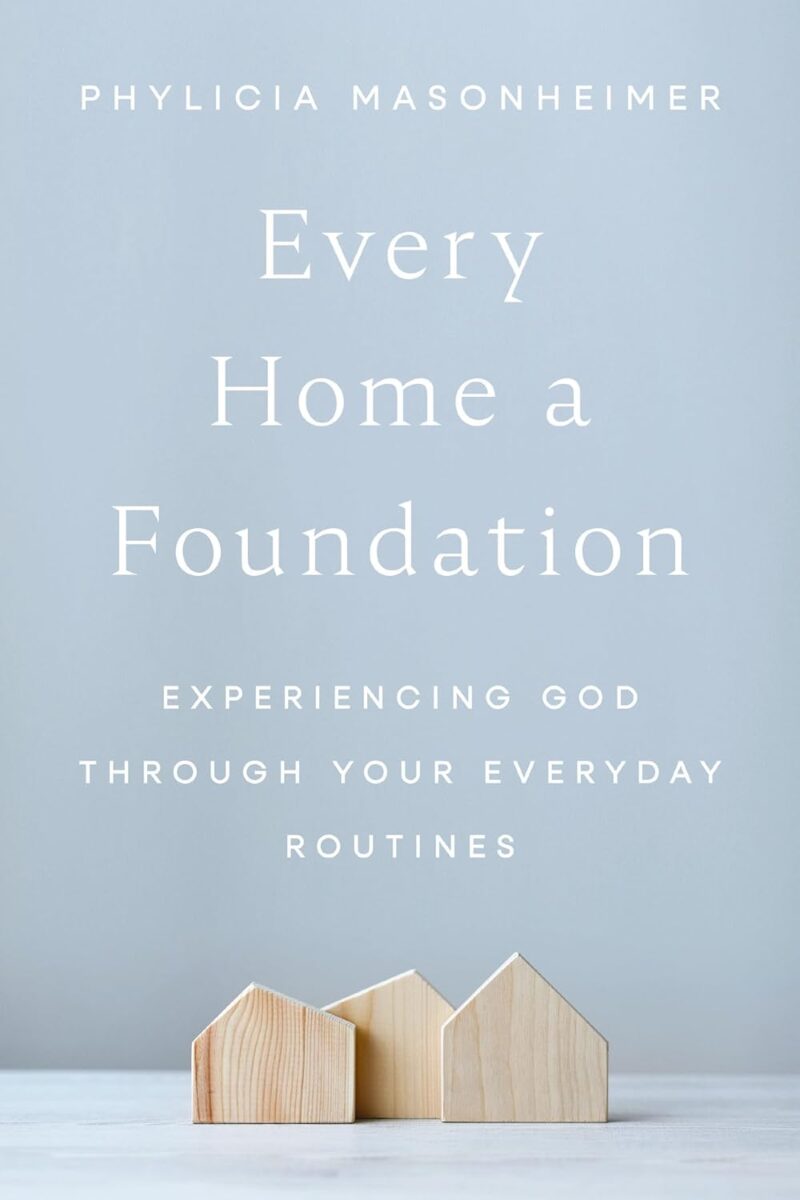
I cannot recommend this book highly enough!
Phylicia Masonheimer is a blogger, author, speaker and podcast host teaching Christians how to know what they believe and live it boldly. Her heart is to teach women the history and depth of the Christian faith; the “why” behind the Bible. Her social media and blog cover topics ranging from sexuality to motherhood to Bible study and faith in seasons of grief and loss.
In Every Home a Foundation, Phylicia Masonheimer invites readers to reconsider their view of home. The Christian home is an image of both a coming spiritual reality and the existing spiritual reality of our family, the church. Through Christ, we can heal and build a home that brings joy to us and love to others.
Every Home a Foundation will transform readers’ view of home from a place of boredom to a place of purpose, train them to find joy in their daily tasks, and equip them to use their home to love others well. Home is much more than a physical structure—it’s a place of belonging and connection that has been strongly tied to God’s mission from the beginning. God wants to build a home for His people, emphasizing the importance of homes as central for the Christian life.
{Our humble thanks to Thomas Nelson for their partnership in today’s devotional.}