Ebie Hepworth knows what it is to keep hoping when hope begins to feel costly. She is living proof that faith isn’t found in pretending disappointment doesn’t hurt, but in discovering that God is still near in the middle of it. In her beautiful new book, Midnight Hallelujah, Ebie gives language to the weary places we so often struggle to name and reminds us that even when the story doesn’t unfold the way we prayed, God’s faithfulness has not changed. It’s a grace to welcome Ebie to the farm’s table today as she shares what it means to meet God at the altar of almost…
Guest Post by Ebie Hepworth
After months of shots, appointments, and holding our breath, we were finally nearing the finish line with our last fertility clinical trial visit just ahead.
Years of pregnancy loss, surgeries, and hearing doctors tell me in a dozen different ways that carrying a baby in my womb was unlikely for me had led to this moment.
Every detail felt divinely orchestrated: a clinical trial offering the exact treatment I’d been told would never work, fully funded, arriving unchased and unexpected. It all felt too poetic, too precise, to go any other way than how I had imagined.
I believed, without hesitation, that God was filling the story with suspense for the sake of a good ending—and that this, finally, was it.


There’s a particular kind of prayer that rises when you’re worn thin by waiting and wanting but something in you still refuses to give up. It’s the prayer of a heart that’s breaking open with longing but is attempting to stay tethered to belief.
We’ve all been there, grasping for hope in any form. Holding it like a flickering candle in the wind. Trying to protect our hearts from unraveling in the what-ifs.
Two days later, the morning of the final blood draw, I waited by my phone all day, expecting good news. When it finally rang, I grabbed my digital camera to record the moment, fully convinced I’d want to relive this miracle for the rest of my life.
“Tell me you’ve got good news,” I said. There was a pause. The kind that tells the news before the words do.
“Ebie . . . your labs came back at twenty-one. Twenty or lower is the number we needed to continue your treatment. I am so sorry . . .”
I didn’t say a word.
“And perhaps that’s the point—worship is not the reward for relief but is the way we contend for hope while the chains are still on. The quiet insistence that every hallelujah offered in the dark becomes part of that sacred architecture of durable hope.“
I just slowly lowered myself to the floor in front of the living room window. The nurse’s voice was soft. “I’m so sorry, Ebie. This is devastating after all you’ve walked through. But with those results, you won’t be able to continue this treatment through the trial.”
And there I was . . . at the altar of almost. The place where we lay the offering that nearly was. The womb that nearly carried. The job that nearly opened. The relationship that nearly ended with a ring. The healing that nearly came. The story that almost went the way you hoped.
This altar rarely comes with closure or clarity, but it does come with its own unique level of pain—because you almost had what you prayed for. It feels as if the rug has been slipped right out from beneath you and that hope was a trap. A punishment for believing.
I sat there in silence, the camera still running. No miracle moment or storybook ending. Just me in a quiet room with hope still warm in my chest and nothing to do with it.
Later that day, I glanced down at my shoe and noticed something stuck to the bottom. A yellow sticky note, smudged and half-creased from being carried for who knows how long. I peeled it off and read the words scrawled across it: Great is Thy faithfulness. I stared at it, stunned. I had been walking on truth my heart didn’t know how to believe, carrying it without knowing.
There is a man in Scripture who was familiar with the painful ache of almost. He wasn’t a king or a warrior. He was a Levite man by the name of Asaph, who spent his life contending with God’s Word. He was appointed by King David (1 Chronicles 6:39) to care for and lead worship at the temple. He is credited with writing twelve psalms, many of which deal with themes of confusion, injustice, spiritual disillusionment, and ultimately, hope. He wasn’t afraid to ask hard questions, and somehow, he kept worshipping anyway.
In Psalm 73, Asaph opens up with a crisis of radical disappointment.
He looks around and sees that the wicked are prospering while the faithful are suffering.
He had done all the right things—prayed in faith, served God, kept his hands pure—yet when he looked around, what he saw nearly undid him. The heartbreak of watching life fall apart for those who believed and come together for the ones who didn’t.
“But as for me, I almost lost my footing. My feet were slipping, and I was almost gone” (v. 2 nlt). That word almost can be heard from a million miles away. The altar of almost is where the faithful stand with shaky knees, wondering if their surrender was foolish and if hope is just the slowest and cruelest way to be disappointed.
But Asaph doesn’t turn away; he brings his ache to the altar and calls it worship.
His story pivots on one verse, the hinge between despair and clarity. I love how Eugene Peterson renders it in The Message: “I entered the sanctuary of God. Then I saw the whole picture” (Psalms 73:17 MSG).
This moment isn’t a change of location as much as a change of posture. Miqdash, the Hebrew word for “sanctuary,” doesn’t just mean a temple. It means holy place, the dwelling of God, a set-apart place for encounter. Can you hear the invitation tucked inside it?
Come close. Let Me show you what you can’t yet see.





“Honest worship is where we gather His heart so that our own doesn’t cave in on itself“
From Eden to Sinai to Solomon’s temple, God has always been after one thing: dwelling with His people. And now, through Jesus, the dwelling place isn’t a structure built by human hands; it’s us.
The sanctuary has moved inside our skin, and returning to a conversation with God is how we keep its doors open. Honest worship is where we gather His heart so that our own doesn’t cave in on itself. It’s what keeps the walls from crumbling when disappointment presses heavy. It’s what lets the light in when confusion fogs the windows.
Worship builds sanctuaries out of ordinary spaces through people with blistered, honest hearts.
“Worship builds sanctuaries out of ordinary spaces through people with blistered, honest hearts.“
It happened once in a prison too. Paul and Silas sat chained in a jail cell at midnight, their backs torn open, their freedom stripped away. In the hour when most people give up, they began to worship. Scripture says the earth shook and every chain fell loose (Acts 16:26).
And perhaps that’s the point—worship is not the reward for relief but is the way we contend for hope while the chains are still on.
The quiet insistence that every hallelujah offered in the dark becomes part of that sacred architecture of durable hope.
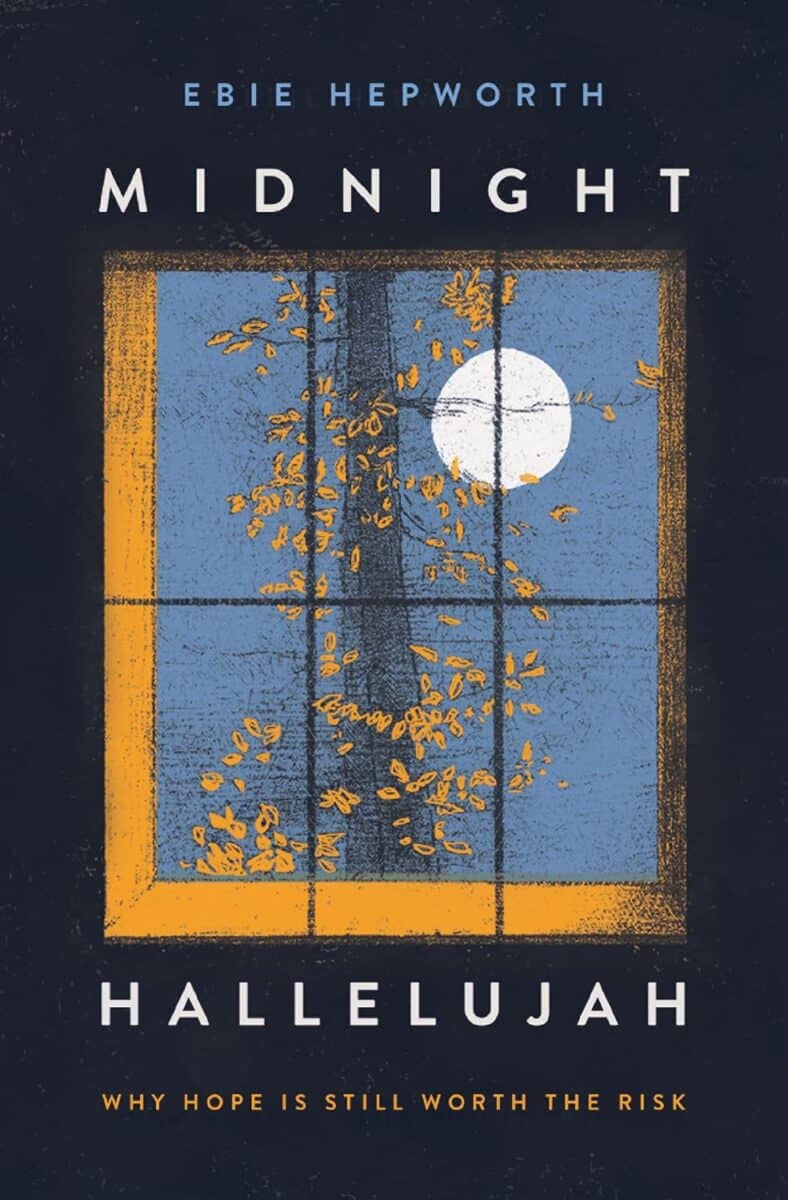
Ebie Hepworth’s words rise from the trenches of real life: adoption and pregnancy loss, a miracle twin birth, and the daily ache of walking her son through a diagnosis of Duchenne Muscular Dystrophy.
She hosts the Let Me Ask You This podcast and serves alongside her husband Zac at their local church in Boise, Idaho, where they live with their four children.
When hope feels fragile and the waiting has gone on longer than you ever imagined, what if you don’t need to force your way back to certainty, but simply discover that God is still with you, even in the dark?
In her new book Midnight Hallelujah, Ebie offers a tender invitation to bring your unanswered prayers, disappointment, and hope fatigue honestly before God—and discover the kind of hope that will hold you through the night.
Follow along with Ebie on her website here or on Instagram @ebiehepworth.
{Our humble thanks to W Publishing for their partnership in today’s devotional.}