Some stories find you at exactly the right moment, and Natasha Kennedy is one of them. She was a children’s book illustrator, a lover of good food and wine, and dreamt of culinary school. Someone, in every sense, made to feast. And then, at thirty-three, she was told she would never swallow solid food again (!!!) What she found in that wilderness, two months of true starvation, confusion, and the terrifying nearness of death, isn’t really a story about food at all. It’s about what happens when the cushions we’ve built around our hearts get stripped away, and we finally come face-to-face with the only One who can truly satisfy. I couldn’t be more glad to welcome Natasha here today…
Guest Post by Natasha Kennedy
You can’t begin to imagine what a profound pleasure it was to sit down to talk with Natasha Kennedy in the belltower of our 1896 old stone church — this is really a NOT TO BE MISSED CONVERSATION…. Don’t miss our powerful video convo below…
“You will never swallow solid food again.”
It didn’t matter how many times I heard the doctor’s words; I could not believe them.
Not me—the lover of all things creamy and delicious; not me—the jovial housewife who spent my evenings drinking wine while I cooked, dreaming of culinary school. Not me, the girl once nicknamed McTasha by friends who always spotted my yellow car at the drive-through. Surely, there was something that could be done! But there wasn’t.
At the age of thirty-three, my esophagus had died, and I didn’t know why.


I love life.
I live for the highs and moments of pure happiness. I have a romantic view of the world, like a bard who writes songs that make the mundane look fantastic. I spin the threads of my everyday life into stories, so that I can point to a tapestry and say, “Look—isn’t this amazing?”
I’ve always taken joy in discovering where God fits into these stories, to let him be the ever-present melody that plays like a theme throughout my otherwise ordinary life.
So what do I do when my story descends cruelly into a cave, one where I can’t see a way out? Where is God when I see no happily-ever-after in my story, when the pain and the loss become so great that I find myself not wanting to walk deeper into the cave?
“My suffering had been experienced by Christ before, and he held the answers to my questions.“
It all started in May, just after Easter. I went into the local emergency room with steak stuck in my throat. This emergency room trip was followed by another, and another, and another. Food would not pass through my esophagus into my stomach, and that was when we were told: my esophagus wasn’t just a tube but a muscle, and mine had stopped working.
From May to July, I could not eat anything. For much of the time, I could not even drink water. I was in the hospital regularly for IV fluids, and when I wasn’t there, I was at home trying to force tiny bits of liquid into my stomach, only to throw it up again. I was starving. I was dying—and I didn’t know why.
It is not until we actually taste the true nearness of death that we start to realize just how imminent it is. This was my moment of truth. I was supposed to be young; I was supposed to have years and years of not thinking about death. I can’t die; I have four children—one of them only a year old! I found myself alone, starving, suffering, and confused. I needed rescue. I needed hope.
My husband, Lindsay, bought me a few books on fasting. We found ourselves asking: What if fasting is good? What if there was a richness that could only be gained through it? During one of the days I felt too near to despair, Lindsay asked: “What if this isn’t the worst thing that’s ever happened to you—what if this is the most special thing about you?”
These questions brought me back to the story of Jesus in the wilderness—forty days without eating, in preparation for his time of temptation. My suffering had been experienced by Christ before, and he held the answers to my questions. I clung to his story, reciting the words he spoke in the wilderness as if those very words kept me alive—and maybe they did.
“Man cannot live by bread alone, but by every word that comes from the mouth of God.” (Matthew 4:4)
It wasn’t until I needed that verse that I realized it was true. It wasn’t food that kept me alive; it was the Word of God. A new hunger began inside me, one that could only be fulfilled by truth. I didn’t need food; I needed him.
But before I could see Jesus as a provider, I first needed to understand what I needed rescue from.
And what I needed rescue from was gluttony—not the kind that necessarily shows up on a scale, but the kind that lives in the heart: the refusal to withhold from oneself an excess of the pleasures of this world. The draw of gluttony isn’t an addiction to pleasure as much as it is an addiction to using pleasure to comfort and numb oneself.
And yet, something unexpected happened. I starved for two months, and as I did, I developed a taste for a kind of prayer I had never before allowed myself: prayer with fasting. I entered deeply into a place of dependency on Jesus.


I made meals for my family, then hid away while they ate them. I sipped some broth, then spat it up. Then I would say those words, over and over: Man does not live by bread alone, but by every word that comes from the mouth of God. I would sit there and be amazed at how okay I was. I was hungry, I was empty, and yet I had enough.
Part of me wishes I could go back and experience those pure, simple moments. The clarity I had in the starvation. It was the oxymoron of emptiness—emptiness that held perfect satisfaction.
Those two months were horrifying, but they were also precious. They forced me to cling hard to my Savior. Suffering need not abandon us to a place of loneliness and defeat. In fact, when we suffer, we are drawn, somehow, closer to Jesus.
The rose-colored glasses I thought were making my experience of this broken world so much better were ripped cruelly from my face.
I found something that satisfies me even more than food.
I have been forced to believe Jesus when he said he would be enough for me—to really stare into the void of what I thought I needed…
… and find something so much better than I had before.
A Deeply Life-Giving Conversation: Belltower Stories
What are we really hungry for? Ann Voskamp and Natasha Kennedy discuss Natasha’s new book, Lacking Nothing. Come join us in BellTower Stories, up in the 1896 bell tower our little Village Table church, as “the bells are the voice of the church, with tones that touch and search.” (Longfellow)
Natasha Kennedy is an author and illustrator based in Seattle, passionate about sharing the beauty and truth of Christ through her work.
She and her husband Lindsay homeschool their four children and share their home with two cats, Curtains and Fauxe. Natasha lives with several debilitating chronic illnesses that cause chronic pain and prohibit her ability to eat, and it is out of that ongoing wilderness that she writes.
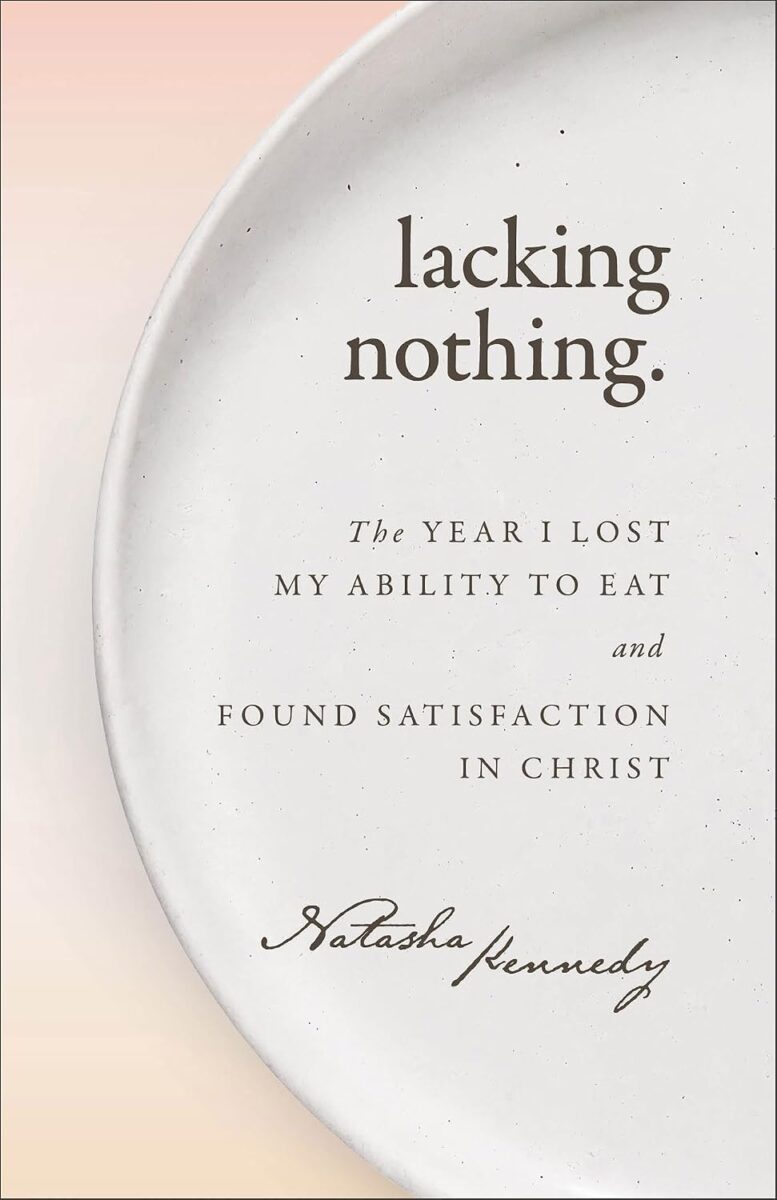
In Lacking Nothing, Natasha tells the story of the year everything she thought she needed was stripped away, and what she discovered when it was. It is a book about fasting and feasting, about gluttony and grace, and about the God who meets us in our emptiness and proves Himself to be more than enough.
It is one of the most searingly honest books I’ve read in years.
Don’t wait on this one. Grab a copy, pass it to a friend who is suffering, and let Natasha’s story remind you, and them, that Jesus is enough.
{Our humble thanks to Baker Books for their partnership in today’s devotional.}