Have you ever felt like your body was the problem, either not enough, or somehow too much? I think maybe most of us have stood in that painful, confusing in-between? Paige Allen grew up as a pastor’s kid in West Texas, spent over twenty years on the same church staff loving the same people, sent missionaries all over the globe, and somehow, in the margins of all that faithfulness, found time to become an honest, disarming voice on what it actually looks like to carry a promise God has given you — and Paige doesn’t let herself off the hook, and she doesn’t let us off the hook either: she just makes you feel less alone in the process. It’s a humble joy to welcome Paige to the farm’s front porch today…
Guest Post by Paige Allen
It was a pleasure to sit down to talk with Paige Allen in the belltower of our 1896 old stone church, for another BellTower Stories conversation. Don’t miss our powerful video convo below…
The first words written about Sarai in Scripture are simple but deeply painful:
“But Sarai was unable to become pregnant and had no children.” There is a finality in that statement, and when you understand that a woman’s worth in the ancient world was tightly bound to her ability to bring children into it, you understand that Sarai enters the story already carrying a label that defines her entire existence.
She is introduced by her lack.
I wonder how many of us do the same.




The enemy is not creative, but he is crafty.
He simply repackages the same lie over and over — tailored to your particular wound, your particular season, your particular body. He packaged it for Sarai as infertility. He packaged it for the Israelites as smallness. He packaged it for me as gender — the whisper that a young woman from Lubbock, Texas had no business trying to launch a missions movement. My guess is that he has packaged it for you too, in some form you’d recognize instantly.
What Sarai didn’t know — what is breathtaking when you see it — is that God had specifically chosen her body.
Not a substitute. Not a stand-in.
“Faith believes what God can do. Identity believes what God can do through you.“
Not any woman who might be more qualified. God’s covenant plan required Sarai’s womb, Sarai’s egg, Sarai’s specific biology. And yet she would spend years believing the opposite: that she was the weak link, the dispensable part, the obstacle to the very promise God was trying to fulfill through her.
Faith believes what God can do. Identity believes what God can do through you.
So when Sarai’s beauty attracted the attention of Pharaoh’s officials and she was taken into the palace — shamed for what her body lacked in one culture, exploited for what it offered in another — God did something stunning. He sent plagues. The same avenue of deliverance He would later use to free an entire enslaved nation? He deployed it for one woman.
God sent the full force of His love and rescue in the form of plagues for one woman. One woman’s body was worth that to Him.
I need you to sit with that for a moment.
“…Comparison exists only when our eyes are on someone other than God.“
Because the lie the enemy keeps whispering — that you are too broken, too limited, too much, or simply not enough — is the same lie Sarai believed. And God kept showing up anyway, saying the opposite. Not once, not twice, but four times He spoke the promise directly over her. He was persistent because He knew: lies that inhabit our bodies are not easily uprooted.
Leah’s story picks up the same thread from a different angle. She wasn’t infertile. She was simply unloved — overlooked by the husband who had eyes only for her younger, more beautiful sister Rachel. The author of Genesis sets up their contrast in two verses: Rachel was lovely. Leah had “weak eyes” — no sparkle.
Jacob wanted Rachel. He got Leah first. And what followed was years of two women living in the shadow of what the other possessed, each one unable to see the particular grace God had extended to her own life.
Comparison exists only when our eyes are on someone other than God.
When Leah bore her first three sons, she named them out of her wound. Reuben: The Lord has noticed my misery, and now my husband will love me. Simeon: The Lord heard that I was unloved. Levi: Surely this time my husband will feel affection for me. Three sons. Three desperate attempts to earn through production what she could not receive as a gift.
But then something shifts. Her fourth son arrives, and the naming is different. No mention of Jacob. No calculation about what this child might finally win her. Just this: “Now I will praise the Lord.”
She named him Judah — meaning praise — and Scripture notes simply that she stopped striving.
We don’t know exactly what changed. Maybe her circumstances hadn’t changed at all. But something in her gaze did. And the moment Leah lifted her eyes from Rachel to the Lord, she stepped into her greatest purpose — because it was this son, Judah, who would one day be the father of David. And from the line of David would come the One Revelation calls the Lion of the tribe of Judah.
The overlooked woman became one of the ancestors of the Savior of the world.





Sarai’s story and Leah’s story are really the same story: God does His most profound work in the women who feel most disqualified.
Not because He overlooks their limitations, but because He sees exactly what He placed inside them — and He is not confused about the gap between where they are and where He is calling them.
He knows your name.
He sees your body.
He is not deterred by your lack.
And He has been trying, persistently and patiently, to tell you so.
Belltower Stories
What if one simple “yes” could change generations? Ann Voskamp and Paige Allen discuss Paige’s new book, Matriarchs: What the Women of Genesis Teach Us About Our Part in God’s Story. Come join us in BellTower Stories, up in the 1896 bell tower our little Village Table church, as “the bells are the voice of the church, with tones that touch and search.” (Longfellow)
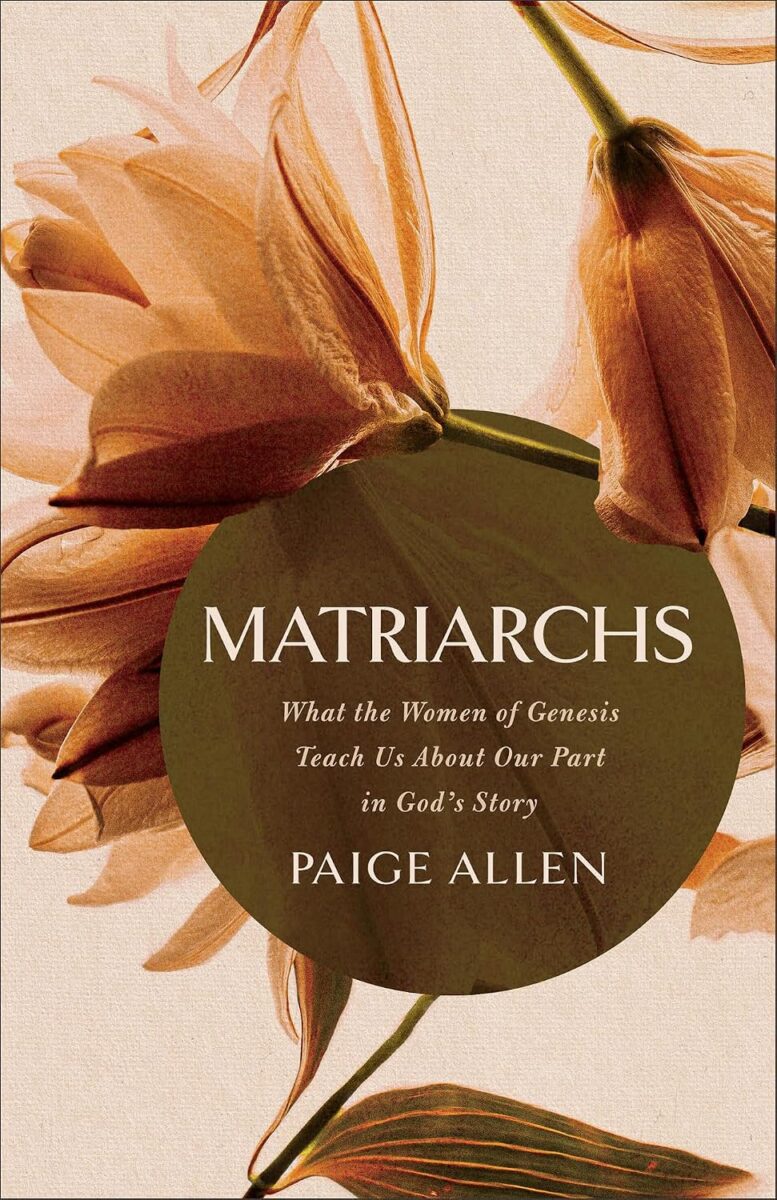
Paige Allen is a pastor, speaker, author, and podcast host who has served on the same church staff at Church on the Rock in Lubbock, Texas for over twenty years.
She holds a Masters of Divinity from The King’s Seminary, founded Pursue Missions in 2007 — an organization now supporting full-time missionaries and short-term teams around the globe — and co-hosts the Bloom Talks podcast. She and her husband Josh have two daughters, Selah and Haven.
And her latest book, Matriarchs, is part Bible study, part personal confession, part battle cry for every woman carrying a God-given promise she isn’t sure she’s qualified to birth. Sarah, Rebekah, Rachel, Leah—these women wandered, doubted, schemed, and strived their way toward a promise they couldn’t fully see.
And God worked through every bit of it. If you’ve ever felt like the weak link in what God is trying to do, this book was written for you.
Order yours today and grab an extra copy, pass it to a friend who is wandering, and let the stories in Genesis remind you and them that Jesus is enough.
And connect with Paige at PaigeAllen.net and on Instagram.
{ Our humble thanks to Baker Publishing Group for their partnership in today’s devotional.}