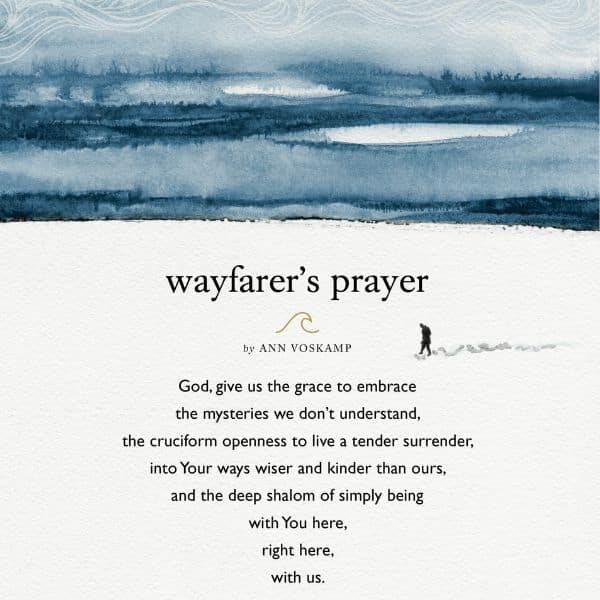
You know hen the world presses in and you feel the weight of it all — where do you turn your gaze? It’s a crazy grace to welcome my friend Brad Gray to the farm today. He comes with this invitation not to shrink from the overwhelming bigness of life, but to look up, to let the cosmos preach a sermon of holy awe! Brad gently turns our gaze toward the heavens, not just to see the stars, but to find the One who holds them—and us—with steadfast love. In the words of the Lord’s Prayer, he helps us remember how to say, “Our Father in heaven,” anchoring us in a way to pray that reorients our perspective and steadies our trust in the Father who is not only powerful but deeply personal. It’a a joy to welcome Brad to the farm’s table today…
Guest Post by Brad Gray
Our Father in the heavens, holy be your name. Your kingdom come, your will be done, on earth as it is in heaven. Give us this day our daily bread. And forgive us our debts, as we also have forgiven our debtors. And lead us not into temptation, but deliver us from evil. For yours is the kingdom and the power and the glory forever. Amen.
Matthew 6:9-13
I was a business management major in college, and my liberal arts program required me to take courses outside my field to “broaden my horizons.” So, to check a box, I signed up for astronomy.
I thought I was just fulfilling a requirement.
Little did I realize it would broaden my understanding of God’s majesty and revolutionize my prayer life.








Like most college students, I was carrying a lot: questions about the future, pressure to succeed, a full calendar, and a gnawing uncertainty about where my life was headed. But when I started looking up at the stars, I discovered two things I didn’t even know I was craving-
A profound experience of awe and a much-needed shift in perspective.
“Awe has a way of shrinking our egos while expanding our souls.“
Awe is what you feel when you stand in front of something so vast and beautiful, your brain can’t compute, like standing on the edge of the Grand Canyon or the summit of a Swiss alpine mountain. All that bigness and beauty leaves you feeling small but not insignificant.
Awe has a way of shrinking our egos while expanding our souls.
It reminds us we belong to something vast and alive, and somehow, we’re part of it. That’s what I felt studying the cosmos. I was thunderstruck by how enormous the universe is and how strangely ordered.
According to astrophysicist Martin Rees, the universe is “shaped by six mathematical constants which, had they varied by a millionth or trillionth degree, would have resulted in no universe or at least no life.” The universe isn’t random. It’s breathtakingly precise.
Our galaxy, the Milky Way, is enormous, about 100,000 light-years across. So if you could hop on a beam of light and travel across the galaxy, it would take you 100,000 years to get from one end to the other, and that’s traveling at 186,282 miles per second. To put that into perspective, since the moment Jesus gave the Lord’s Prayer two thousand years ago, light has only traveled 1/50th of our galaxy!
We live in an astonishing universe! And somehow the God who flung those stars into space isn’t just powerful; he’s also personal.
As we reflect on his wonders, we can say with the psalmist, “When I consider your heavens, the work of your fingers, the moon and the stars, which you have set in place, what is mankind that you are mindful of them, human beings that you care for them? You have made them a little lower than the angels and crowned them with glory and honor” (Psalm 8:3–5).
That’s the paradox of awe. It makes us feel small but never unseen. For me, that realization changed everything.
The sheer scale and precision of the universe did more than stir wonder, it stirred trust.
“…somehow the God who flung those stars into space isn’t just powerful; he’s also personal.“
If God is big enough to hold all this together, then surely he’s big enough to hold me together too. That thought began to reshape how I saw my life, how I prayed, and how I walked with God in seasons of uncertainty.
The stars were witnesses to a presence I could rely on.
That feeling of awe, the inner stillness that captivates you in the face of something vast and beautiful, isn’t just emotional. It’s spiritual. Rabbi Abraham Joshua Heschel wrote, “Awe is a sense for the transcendence, for the reference everywhere to the mystery beyond all things. It enables us to perceive in the world intimations of the Divine.”
Heschel understood that awe does more than make us feel small. It helps us perceive that which is beyond and behind and beneath all things, and connects us more deeply to the one who holds it all together. I don’t know about you, but that’s the kind of perspective I desperately need, because let’s be honest: Life doesn’t always feel like it’s being held together by a wisdom and power from beyond.
Instead, it usually resembles a relentless game of Whac-A-Mole—deadlines, setbacks, and fires to put out. We read the news and feel a shudder deep inside. A text message turns our world upside down. Global crises, personal disappointments, and the confusion about where any of this is headed make it feel like life is unraveling, like we’re hurtling headlong toward apocalyptic doom, not a new creation.
When that sense of unraveling takes over, it awakens all our worst instincts: fear, anxiety, control, fight-or-flight,and self-preservation. In those moments, we wonder, Is anyone really in control?
Consider this for a moment, though: What if that very sense of overwhelm could serve as a signal? What if it’s not evidence that God is absent but an invitation to elevate our perspective?
That’s what Jesus invites us into every day when we pray, “Our Father in heaven” (Matthew 6:9). Saying those words helps us shift our focus, not just to who God is, but to where God is. Not geographically, but cosmically. He’s enthroned in heaven: above the chaos, beyond the noise. He sees what we can’t. He rules with wisdom and perspective we don’t have. And he holds together what feels like it’s falling apart.
“So when life feels unstable, “Our Father in heaven” becomes a kind of spiritual overview, an invitation to reorient our hearts by lifting our eyes to the one who stretched out the galaxies and still knows us by name.“
As God himself declared, “As the heavens are higher than the earth, so are my ways higher than your ways and my thoughts than your thoughts” (Isaiah 55:9).
So when life feels unstable, “Our Father in heaven” becomes a kind of spiritual overview, an invitation to reorient our hearts by lifting our eyes to the one who stretched out the galaxies and still knows us by name.
When we set out to film season one of The Sacred Thread, we knew it would be a massive undertaking, creating seven episodes connected to the Lord’s Prayer filmed across multiple countries. But we couldn’t have guessed the extensive challenges it would involve.
One of the countries kept closing the door to us even though we had filmed there before without issue. We followed every protocol, submitted the proper paperwork, and exhausted every possible connection, and still the permission never came.
Throughout that draining, confusing, sometimes heartbreaking season, I found myself praying, God, why now? Why this? You called us to this work. You’ve carried us through so much. Why leave us hanging here, so close to the finish line?
In moments like these the phrase “Our Father in the heavens” anchors me. Because if God really is in the heavens—if he sees what I can’t, knows what I don’t, and holds the whole story together—this closed door isn’t the end. It’s just part of the story I don’t understand yet.








He’s the one who created the cosmos and sustains every atom. He’s not lost. He’s not late. He’s not unaware.
Maybe you’re in a similar place right now, staring at a closed door, stuck in a waiting season, carrying questions that have no answers. If so, here’s what I invite you to do:
Take a break, step outside, and look up.
Let the night sky remind you that you’re not alone. Let the stars preach to you. Our Father is in the heavens. He’s above it all and with you in it all.
He sees. He knows. He’s got this.
And you can trust him — even here.
Abraham Joshua Heschel, I Asked For Wonder: A Spiritual Anthology (Crossroads Publishing Company, 1983), 21
Brad Gray is the President and CEO of Walking The Text, a non-profit organization that creates digital media resources and study trips to Bible lands to help people understand the Bible in its original context. He is the co-creator and host of The Lord’s Prayer film (available on Angel) and The Sacred Thread series (releasing early 2026). Brad is also a national speaker, ordained minister, former teaching pastor, and author of Make Your Mark.
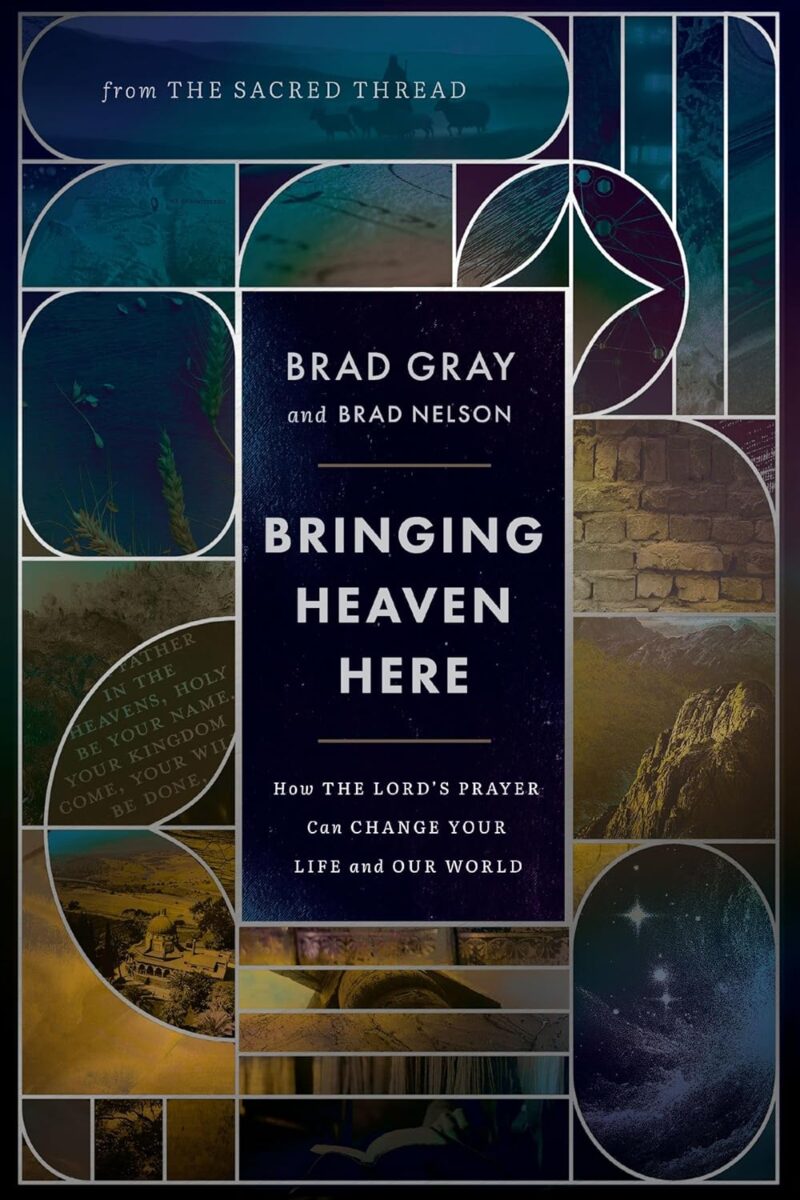
Brad’s new book Bringing Heaven Here: How the Lord’s Prayer Can Change Your Life and Our World invites you to see this prayer the way Jesus first gave it—in its original context of history, culture, and everyday life. When you do, the Lord’s Prayer stops feeling like a routine and becomes a blueprint for discipleship. It’s the same prayer that sustained Jesus himself, and it’s meant to sustain us too.
To learn more about the book, visit bringingheavenhere.com. For more on the film and series on the Lord’s Prayer, visit thelordsprayer.com.
{Our humble thanks to Thomas Nelson for their partnership in today’s devotional.}