There are stories you read once and there are stories that read you every Christmas. I was ridiculously thrilled when I first opened A Little Christmas Carol — honestly, overwhelmed with wonder in my heart. The amazing artwork of Joe Sutphin has taken the beloved Dickens classic and somehow made it new again — tender, true, and lit with the kind of hope we ache for in December. Joe Sutphin doesn’t just illustrate — he illuminates. His art slows you down enough to feel the story, to notice grace in the smallest gestures, to see how even the coldest hearts can be warmed by Love Himself. I cannot recommend this enough: This Christmas, gather around the fire with your family and a copy of Little Christmas Carol. You’ll be reminded that light still breaks through, that redemption still finds us, and that Christmas is still the miracle our weary world needs. It’s a tremendous joy to welcome Joe to the farm’s table today…
Guest post by Joe Sutphin
The best way to experience Little Christmas Carol is to read it aloud — real wonder!
“It is good to be children sometimes, and never better than at Christmas, when its mighty Founder was a child himself.” – Charles Dickens
Charles Dickens discovered this himself, and started a side career where he gave public readings of his famous tale.
Something about the story grabs the public imagination and appeals directly to the children who hear it.
Perhaps this is because Dickens infused his story with references to simple, childlike Christian faith: “It is good to be children sometimes, and never better than at Christmas, when its mighty Founder was a child himself.”
Lines such as this have provoked a long discussion about what Charles Dickens meant.


Strictly speaking, A Christmas Carol is not a gospel story–the author makes no mention of the death, burial, and resurrection of Christ. He does, however, construct a secular story with a spiritual theme, one that points to Christ with Scripture allusions and symbolism. At the very least, A Christmas Carol can be seen as a Victorian fable, almost a parable, or perhaps a morality play.
The story begins when Scrooge, a “covetous old sinner,” confronts the natural consequences of his miserable life– “the lonely darkness over an unknown abyss, whose depths were secrets as profound as Death.” For Scrooge, the church had “became invisible” under the cover of a dark fog, offering no solution.
Tiny Tim enters the story to remind us of Christ’s compassion: “He hoped the people saw him in the church, because he was a cripple, and it might be pleasant to them to remember upon Christmas Day, who made lame beggars walk and blind men see.”
Dickens frames Scrooge’s transformation as a journey from darkness to light. At the end, the misty fog departs with “the churches ringing out the lustiest peals he had ever heard. . . . Oh, glorious, glorious!”
Literary critics have noted these themes and have pointed to an unbroken thread stretching back to The Pilgrim’s Progress. John Bunyan’s allegory addressed the burden of sin and the promise of salvation through Christ. Dickens reflected further on the implications of the Great Commandment–to love God first, then love your neighbor as yourself.
Every family can learn how to show kindness, respect, and compassion for the people we meet. As we do, we find the same joy that Scrooge experienced.
And this edition of Little Christmas Carol , it’s based on the 1843 text of A Christmas Carol by Charles Dickens, updated and lightly edited to create a read-aloud experience for families with young children. The illustrations by Joe Sutphin continue the acclaimed visual style of Little Pilgrim’s Progress, an animal world where no humans are seen, set in nineteenth-century London. In keeping with the original text, the narrator speaks directly to the reader at times (look for the Charles Dickens moth who pops up in various scenes!). We hope this new edition will encourage families to make meaningful and lasting memories together through books.
This? Becomes a read-aloud family!
I mean — listen to this timeless classic :
“A Merry Christmas, Uncle! God save you!” cried a cheerful voice. It was the voice of Scrooge’s nephew, who came upon him so quickly that this was the first intimation he had of his approach.
“Bah!” said Scrooge, “Humbug!”
He had so heated himself with rapid walking in the fog and frost, this nephew of Scrooge’s, that he was all in a glow; his face was ruddy and handsome; his eyes sparkled, and his breath puffed again.
“Christmas a humbug, Uncle!” said Scrooge’s nephew. “You don’t mean that, I am sure.”
“I do,” said Scrooge. “Merry Christmas! What right have you to be merry? What reason have you to be merry? You’re poor enough.”
“Come, then,” returned the nephew heartily. “What right have you to be dismal? What reason have you to be morose? You’re rich enough.”
Scrooge having no better answer ready on the spur of the moment, said “Bah!” again, and followed it up with “Humbug.”
“Don’t be cross, Uncle,” said the nephew.
“What else can I be,” returned the uncle, “when I live in such a world of fools as this? Merry Christmas? Out with your merry Christmas! What’s Christmastime to you but a time for paying bills without money; a time for finding yourself a year older, and not an hour richer; a time for balancing your books and having every item in ’em through a round dozen of months presented dead against you? If I could work my will,” said Scrooge, indignantly, “every idiot who goes about with ‘Merry Christmas’ on his lips should be boiled with his own pudding, and buried with a stake of holly through his heart. He should!”
“Uncle!” pleaded the nephew.
“Nephew!” returned the uncle, sternly, “keep Christmas in your own way, and let me keep it in mine.”
“Keep it!” repeated Scrooge’s nephew. “But you don’t keep it.”
“Let me leave it alone, then,” said Scrooge. “Much good may it do you! Much good it has ever done you!”


“There are many things from which I might have derived good, by which I have not profited, I dare say,” returned the nephew.
“Christmas among the rest. But I am sure I have always thought of Christmastime, when it has come round–apart from the veneration due to its sacred name and origin, if anything belonging to it can be apart from that–as a good time.”
“A kind, forgiving, charitable, pleasant time–the only time I know of, in the long calendar of the year, when men and women seem by one consent to open their shut-up hearts freely, and to think of people below them as if they really were fellow passengers to the grave, and not another race of creatures bound on other journeys.”
“And therefore, Uncle, though it has never put a scrap of gold or silver in my pocket…
I believe that it has done me good, and will do me good; and I say, God bless it!”
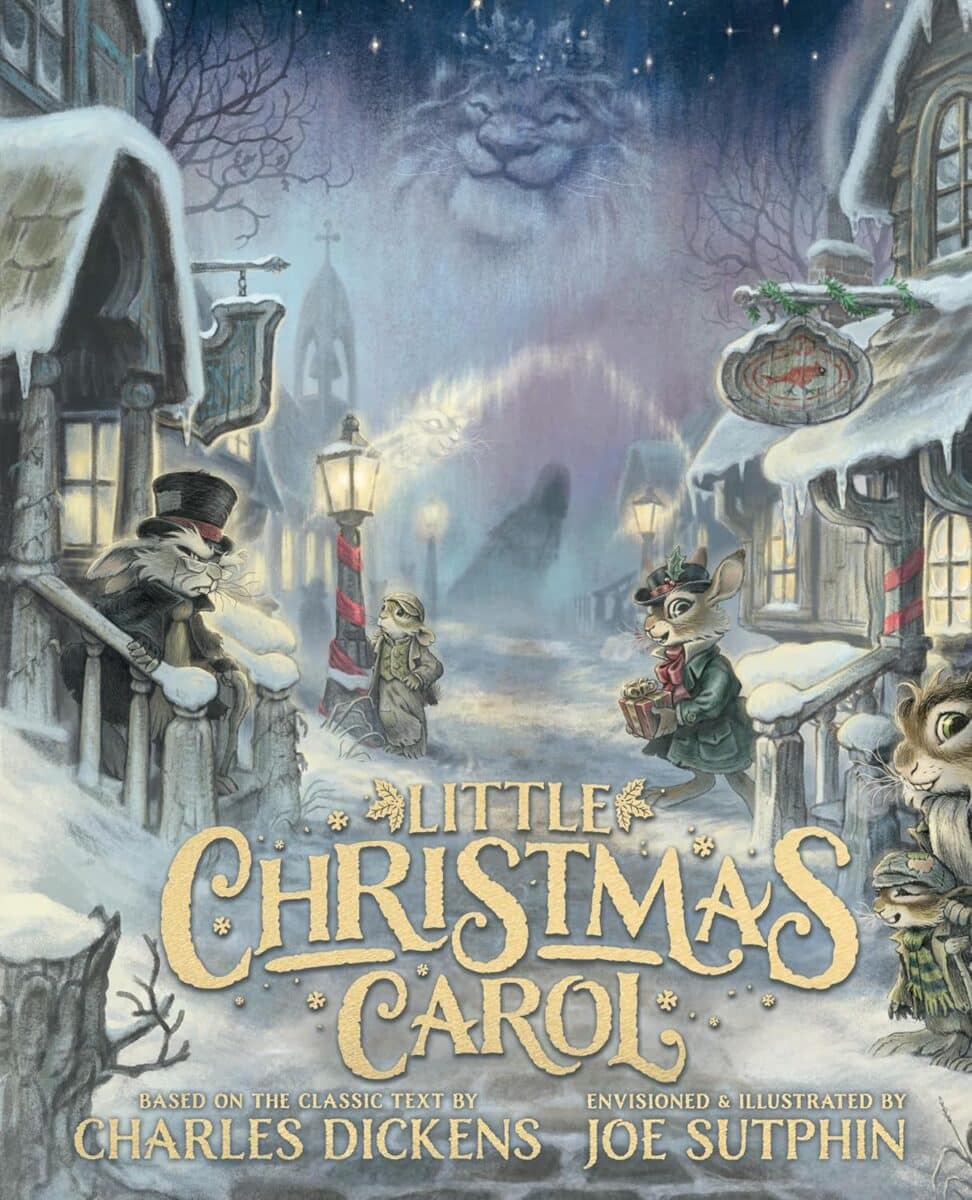
Our family absolutely LOVES the work of Joe Sutphin who illustrates children’s books and graphic novels.
These include the timeless classics Little Christmas Carol and Little Pilgrim’s Progress , the official graphic novelization of Richard Adams’s masterwork Watership Down, Andrew Peterson’s beloved Wingfeather Saga, and more! THESE ARE GORGEOUS CLASSICS for every child’s library!
Joe’s fascination with nature, and the living creatures in the fields and woods around his home, has informed his art for much of his life. Joe lives in a barn with his wife, Gina, and a bunch of cats.
As a family, we will be reading Little Christmas Carol and our youngest will be working through the Little Christmas Carol Activity book! — what a gift to every family!
{Our humble thanks to Moody Publishers for their partnership in today’s devotional.}