I
became a mother on the very eve of Mother’s Day — and my journey toward motherhood began with the very first words I heard in that doctor’s office, as I sat there reeling over those pink strips on my pregnancy test:
“Have you thought at all about an abortion?”
I was a third-year university student. Starting my third week, of my third year. Just blown out the candles on my 21st birthday cake.
Married only a whole shaky 120 days.
And those pink strips on that pregnancy test were making the room spin, my head spin. I felt like there was no way to breathe. I felt like the room had no oxygen. I’d bent over the tiles of the doctor’s office like I might hurl.
Like I might lose everything.
Sometimes abortion isn’t so much about a woman having a choice — but a woman feeling like she has no choice at all.
It’s not like I saw the doctor spin her chair or saw her lean forward. I just heard the mechanics of her rotation, the horrible spinning of everything.
“Really — honestly, have you thought about an abortion?”
For one lifelong moment, the atoms of everything split and spun and hung.
I felt like there was no way out of the room, like there was no way out of this story. I felt like there was no way.
I was in crisis. I was wrestling hard. I was in a hard place.
Sheer terror can make people feel like all they have is terrible choices.
Sometimes abortion isn’t so much about a woman having a choice — but a woman feeling like she has no choice at all.
This is part of my story.

And the story of women, of bodies, of pregnancy, of foetuses, of unborn children, and what it means to be a human being, free to truly flourish, is a deeply complicated, nuanced, painful, charged story, for each of us personally, and for all of us collectively.
For a myriad of reasons, each of us, on both sides of this discussion, are deeply entrenched in our own perspectives, so there is, for a myriad of reasons, little movement from our own positions.
Is there space for considering what if — instead of focusing on telling the other side what to think — we each focused on the other’s humanity, and told stories of what happened to us?
What if instead of just trying to get people to move their position — we moved the position of our hearts closer to all kinds of people?
What if instead of immediately writing off the other side, we listened longer to the other side, to write more of an enduring hope into all of our stories?
My story includes that doctor’s office and a nauseating swirl of questions, the most haunting one simply being:
Is the unborn really one of us? Are the pre-born — are they truly human beings like us?
The science textbooks at university testified: Based on universally accepted scientific criteria, “a zygote — an embryo, is the beginning of a new human being.”
Humans do not merely come from a zygote. All humans were once actually an actual zygote.
Humans do not merely come from a fetus. All humans were once actually an actual fetus.
And I asked myself if that’s why no one says, “We are having a fetus!” — because maybe there is a knowing that we’re having a baby — we are carrying a human being.

And then, for me there, there is all of Stephen Schwartz’s profound wisdom regarding size, level of development, environment and dependence, that form more questions into all the whirl of questions around an unexpected pregnancy:
The human in utero may be small — but does the size of a human being ever determine the value of a human being?
The human in utero may be be a less developed — but does the developmental level of a human being ever determine that one has less worth as a human being?
The human in utero may be in a singular, particular environment — but does where a human being is ever determine whether one is respected as a human being?
The human in utero may be more dependent — but does being dependent on another human being for life ever determine that anyone can simply end your life?
[see Stephen Schwarz‘s SLED.]

What if we were all simply Pro-human, for all humans, in all places, in utero and in crisis?
And, for me, I had to sit in a doctor’s office and sit with the reality:
Whenever in history we have dehumanized anyone, we can begin to legitimize anything.
And I ached: Is there a way to be Pro-Human, somehow to be both for the human in utero, and for the human in crisis, for the human in every story?
Ultimately, the abortion debate is undebatably a failure of community. Every abortion is a failure of all of humanity: failing to support a human being in crisis, and a human being in utero.
Maybe somehow there’s an option to be Pro-Human and Pro-Voice, to be for every human, womb to tomb, and believe that every human being has a voice — and we listen to every story, and lovingly show up and sacrifice for every human.
To have any credibility in any discussion around abortion, we first must have the dependability of always being the ones who readily sacrifice and relentlessly advocate for all vulnerable women, and responsible men, and the value of all unborn and born children.

As I sat scared and overwhelmed and undone in that doctor’s office, a desperately young 21, and hardly married, and completely upended, I wondered:
What if the abortion debate is more than just about how any laws might or might not change — but about how everyone needs to rise up and change how we show cruciform love to anyone in an unexpected place?
What if the abortion debate is not so much who alone is ultimately responsible, but how no one is ever alone and the Body of Christ is response-able — able to respond with love and compassion and support to every woman and child and man.
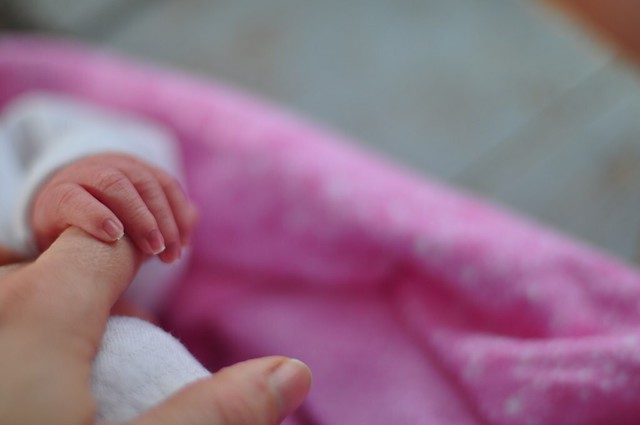
The compassion of Christ-followers needs to literally and practically and sacrificially be: “We will not rest until all humans beings get to be born, because both they, and their parents, are seen, safe, supported and sincerely wanted.”
What if we did not rest until every single person in the church is stirred en masse to personally support one woman in need, one child in need, one man in need, one family in need of community, and keeping work toward family preservation and flourishing in a myriad of ways?

What if we did not not rest until we realize that it’s all of us who have to make ethical choices about our lives — from how we support viable minimum wages, to where we buy our clothes and our food and our entertainment, and how are we our pro-human employers, and educators who are pro-pregnancy, and adapting jobs environments, offering paid maternity leaves, adapting educational options — if we are ever to ask women and men in unexpected places to make ethical choices about human life?
Being Pro-Human will mean being offering real help and not leaving anyone in need.

Envisioning a world without abortions, means we have to envision a world in which every single one of us have to sacrifice so that all of women’s needs are better met, so her future shines with brighter possibilities, so her dreams grow with wider and deeper hope.
Because being Pro-Voice, Pro-Human means putting our Gospel where our mouth and hands are.
Because the call of the Church is never to stir up judgement, but to stir up love, stir up courage, stir up kindness — and that change begins with us.
What if we all committed to no more outrage — and far more outreach?
Change won’t be enacted until we all change the way we are willing to listen to each other and sacrifice for each other.
Outrage alone over abortions will never stop abortions; what always starts lasting change is outreach.
What if, for all of us: Our honest outrage must grow into helpful, holy outreach — if we are ever going to help all humans grow and flourish.
And twenty-some years now after that doctor turned around in her chair, to ask me with that positive pregnancy test that one question, there is my quiet answer, one that stops all the spin in this old spinning world:
In the midst of a heartbroken world, there are always breakthroughs, when there is more outreach than outrage.
When we genuinely reach out to just one person who thinks differently — we get to all genuinely love and live differently.
When we listen better, we begin to love and live better.
When we don’t turn away, but reach out, to someone in need — everything could actually begin to turn around.